
“Passata Remoto” is an Italian term for events or actions in the remote past that may not necessarily hold relevance in the present. Yet, there are certain groundbreaking works that arouse discussions and bring about transformations over decades. One such work is Elizabeth Gilbert’s classic Eat Pray Love. As the book completes two decades, one is made to wonder how, with over 2 million copies sold worldwide, this book brought a cultural movement like never before. Amidst the whirlwind of opinions around the New York Times Bestseller is an undeniable cultural legacy that continues to amplify as time passes.
In the introduction, Gilbert reveals that during medieval times, when European crusaders travelled East for holy wars, they brought ’jap mala’ or a string of beads as rosary. Similarly, she herself travels to three culturally distinct countries to seek three elements that each is traditionally purported to excel at, namely Italy, India and Indonesia. Through this voyage, she and her readers return with new friendships, lessons and most importantly, a blend of cultures that equalizes various geographies within the same plane. While there are a plethora of schools of thought that support and critique this book, it all boils down to it becoming an incredible piece of art that has continued to inspire discussions and commentaries throughout the world. In social media terms, ‘Eatpraylove’ remains a relevant hashtag for all travel and love content. At its core, what the book does is challenge societal stereotypes and moulds that define our roles in the cultural ecosystem. Culture defines expectations; for instance, the expected choice for a woman after some years of marriage is to have a baby. But here came Gilbert, opposing the cycle of family and continuity and deciding to take a year-long trip to find herself.
While some would call her decision selfish, many point to how this is a privileged choice from a financial and career viewpoint. There’s a wide pool of criticism against the book, calling it ‘shallow’ and ‘pretty’, pointing out the sheer privilege to sunbathe and eat gelato in Italy for four months. In 2010, Bitch Magazine (now defunct) attributed a new title, “Wealthy, Whiny, White”, to Gilbert’s book. Similarly, Sandip Roy wrote for Salon, “It’s not Gilbert’s fault, but I have an instinctive reflex reaction to books about white people discovering themselves in brown places. I want to gag, shoot and leave.” The intersectional privilege of colour and wealth often compounds to negative criticisms around the narrative. At the same time, how many of us have the luxury to take a year-long trip to find ourselves?
However, it all narrows down to a woman’s agency and putting herself first to find “a room of her own.” Using the metaphor of a room, Virginia Woolf pointed to women having personal space to give vent to their creative endeavours and achieving social and economic freedom. Though privileged on many levels, Gilbert’s journey is reflective of that autonomy that Woolf dreamt for.
Not to ignore, this agency comes with a great deal of responsibility that women have to account for. She writes, “What I’ve only recently realized is that I not only have to become my own husband, but I need to be my own father, too.”
In a conventional setup, ‘pleasure’ and ‘devotion’ are not seen to go hand-in-hand. Again, Gilbert becomes an ‘antevasin’ or in-betweener who is neither a householder nor a sage.
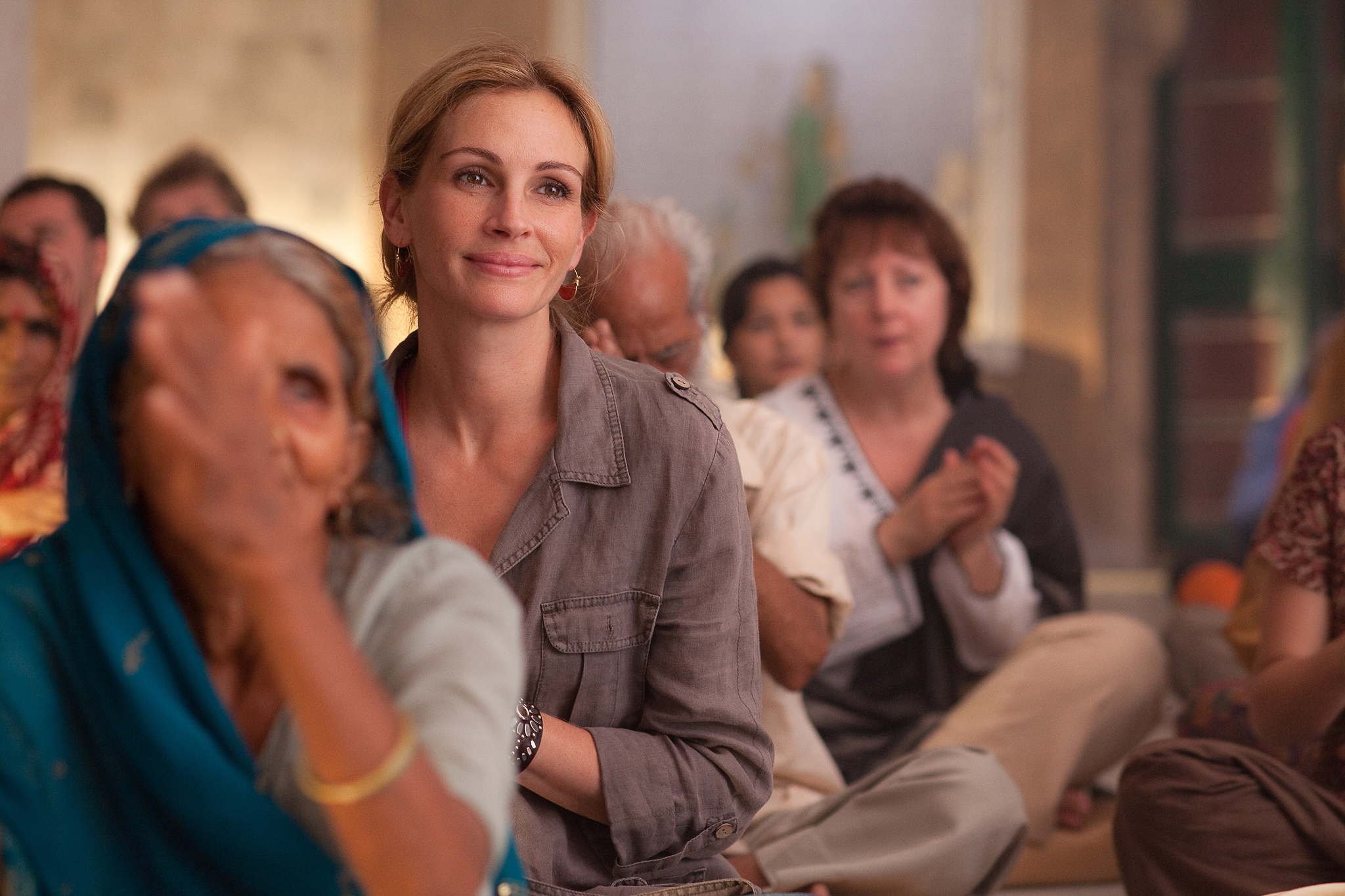
The book also paints how, just like people, countries too have a face and energy that represent them. For instance, Gilbert doesn’t picture yoga and Italy going well together! At the same time, there are characteristics that define each space. Americans don’t know how to relax, while Italians know the art of doing nothing are some cultural tropes that the narrative explores.
While these varied features can be easily moulded to draw differences, we see Gilbert discussing Italy in Bali with a man named Mario, who loves Italian culture even though he has never been there. Through such examples, the writer makes it a point to find beauty in diversity and lead a cultural movement beyond borders. This also makes one think about the notion of roots vs routes where places of travel and new cultures help one fulfil the quest of belonging.
Not to forget, it was only through the coming together of her experiences in Italy, India and Indonesia to seek pleasure, devotion and balance that she is able to achieve a sense of ‘completeness.’
This brings one to think of travel and its impact on cities and their cultures. During the Middle Ages, Popes focused on city planning because there was an influx of Westerners in Italy. Similarly, many accord the book with reviving tourism in Bali after the bombing in 2002. The then head of the Bali Tourism Board, Ngurah Wijaya, stated that it is hard to measure the number of visitors Indonesia received as a result of “Eat, Pray, Love.” However, he claimed that it has had a “great impact” to make “people understand that Bali is safe.”
However, the book also received backlash from many for the gentrification of the peaceful Ubud into a bustling town of tourists. With this rise in tourism, the charm of its quietness and spiritual connection was challenged. Many comment on how spirituality too became a commodity to attract followers of the Eat Pray Love phenomenon.
Culture is driven by a variety of factors, including history, traditions, and languages, among others. Gilbert points at the bloodshed and suffering that constitute the ‘beauty’ of the present. Whether it is Rome’s great food contrasted with the rubble of World War II or the corruption behind the smiles and flowers of Bali, these iconic travel destinations quietly hold within them volumes of inequalities and oppression. As Gilbert says, “In a world of disorder and disaster and fraud, sometimes only beauty can be trusted. Only artistic excellence is incorruptible.”
Gilbert puts forward the case of Yudhi, a Christian who grew up in Jakarta. He moved to America, lived his American dream and then suffered oppression under the Homeland Security Act of 2002. A Christian suspected of being a Muslim in America, a narrative of religious and geographical absurdities.
In moments like these, one often finds recourse in places and people of belonging. However, quite ironically, in Yudhi’s case, he faces more prejudice upon returning to Indonesia and finally finds some sense of belonging in Gilbert, an American woman who herself has chosen Bali in search of balance. Both Yudhi and Gilbert have failed to fulfil their respective American dreams but taken a step to find themselves through their newfound friendship.
It is also reflective of the fact that when calamity calls, humanity thrives, and it doesn’t account for what nationality or religion one follows. For instance, when Wayan, the divorced Balinese traditional healer, was on the verge of losing her livelihood and housing, people from across the world came together to buy her a house. It is believed that post the success of the book, there was an overwhelming demand for Wayan’s services, making it hard for her to manage her time. It also propels into wider discussions around reimaging cultures beyond the parameters of “self” and the “other.”
‘Privilege’, ‘superficial’ and ‘flawed’ will always be words associated with Gilbert’s narrative, but that wouldn’t stop people from talking about it. As Nick Cannon once remarked, “Art is supposed to spark conversation and make people think.”
After two decades of publication, the book continues to teach women across different age groups that sometimes, it’s fine not to have everything figured out. Eat Pray Love exists between dichotomies of privilege vs empowerment, self vs other, and spiritual vs material.
Despite these dualities, what it does effortlessly well is to tie threads of many cultures together with compassion, making it worth revisiting for conversations around culture, travel and women.
 Isha is a writer based in Toronto. She is passionate about stories that cut across time and geography. She has completed a postgraduate certificate in Professional Writing and Communications and her bachelors in English Literature.