
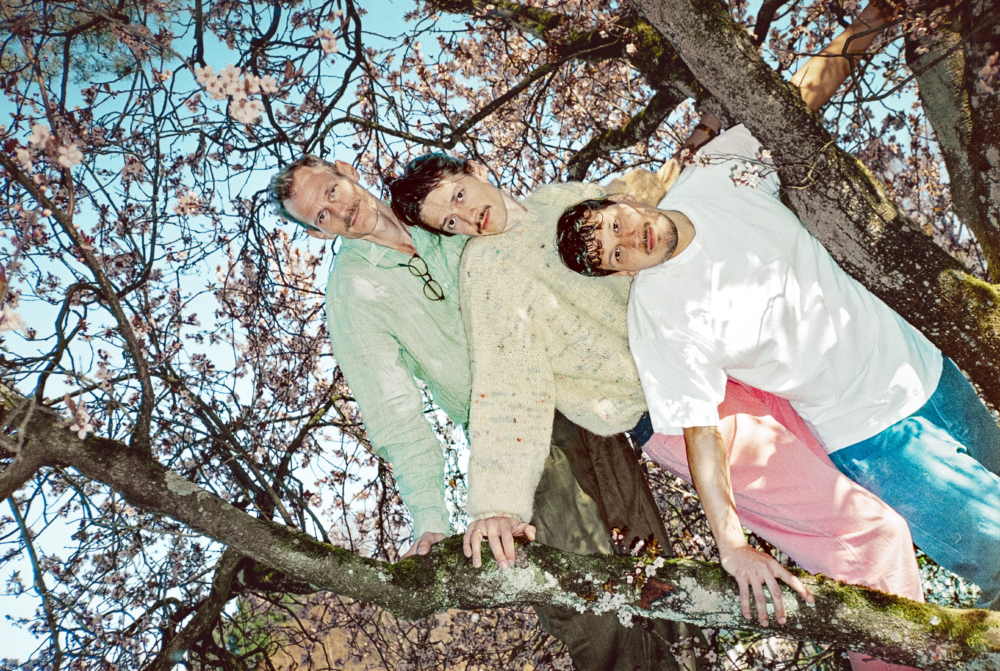
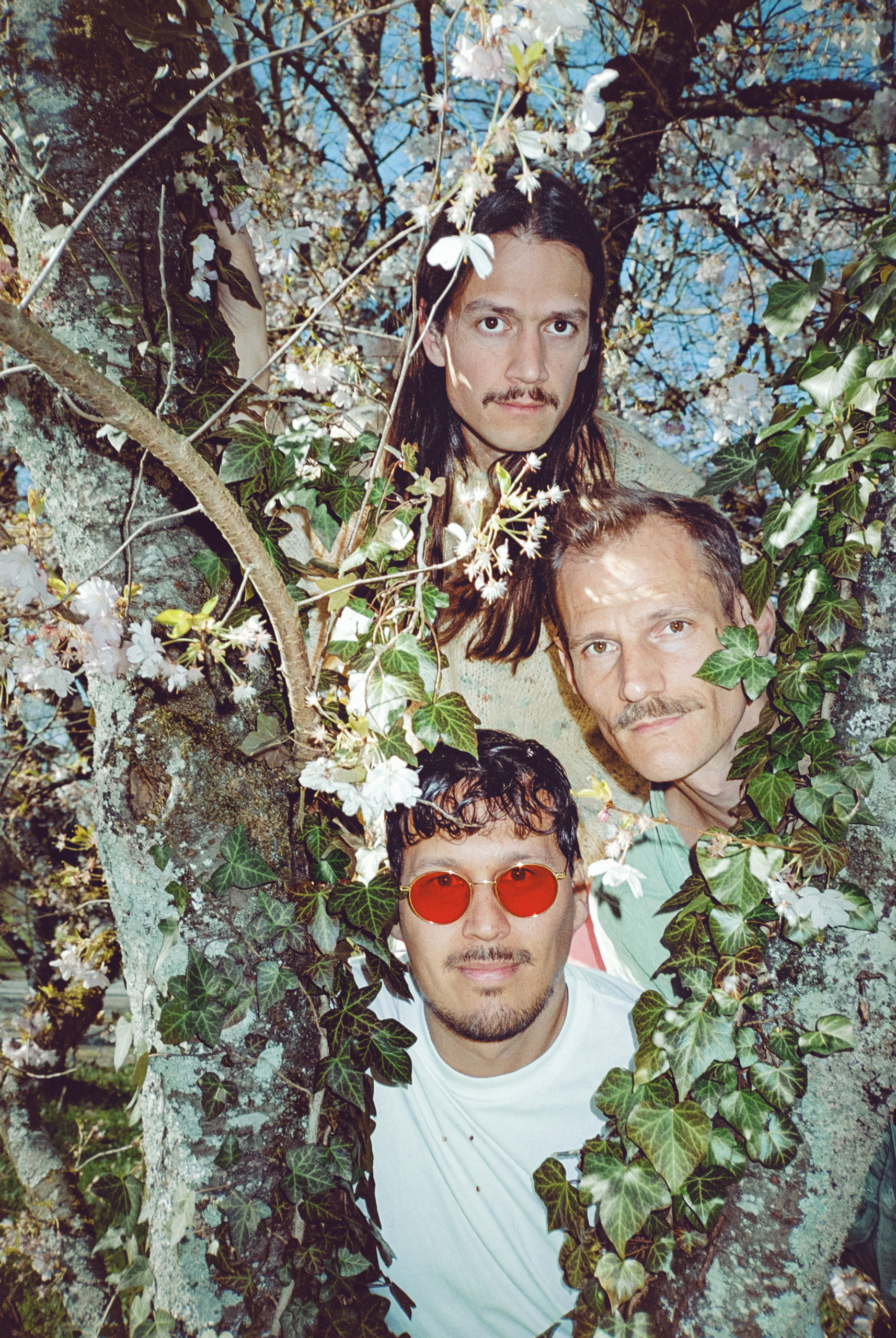
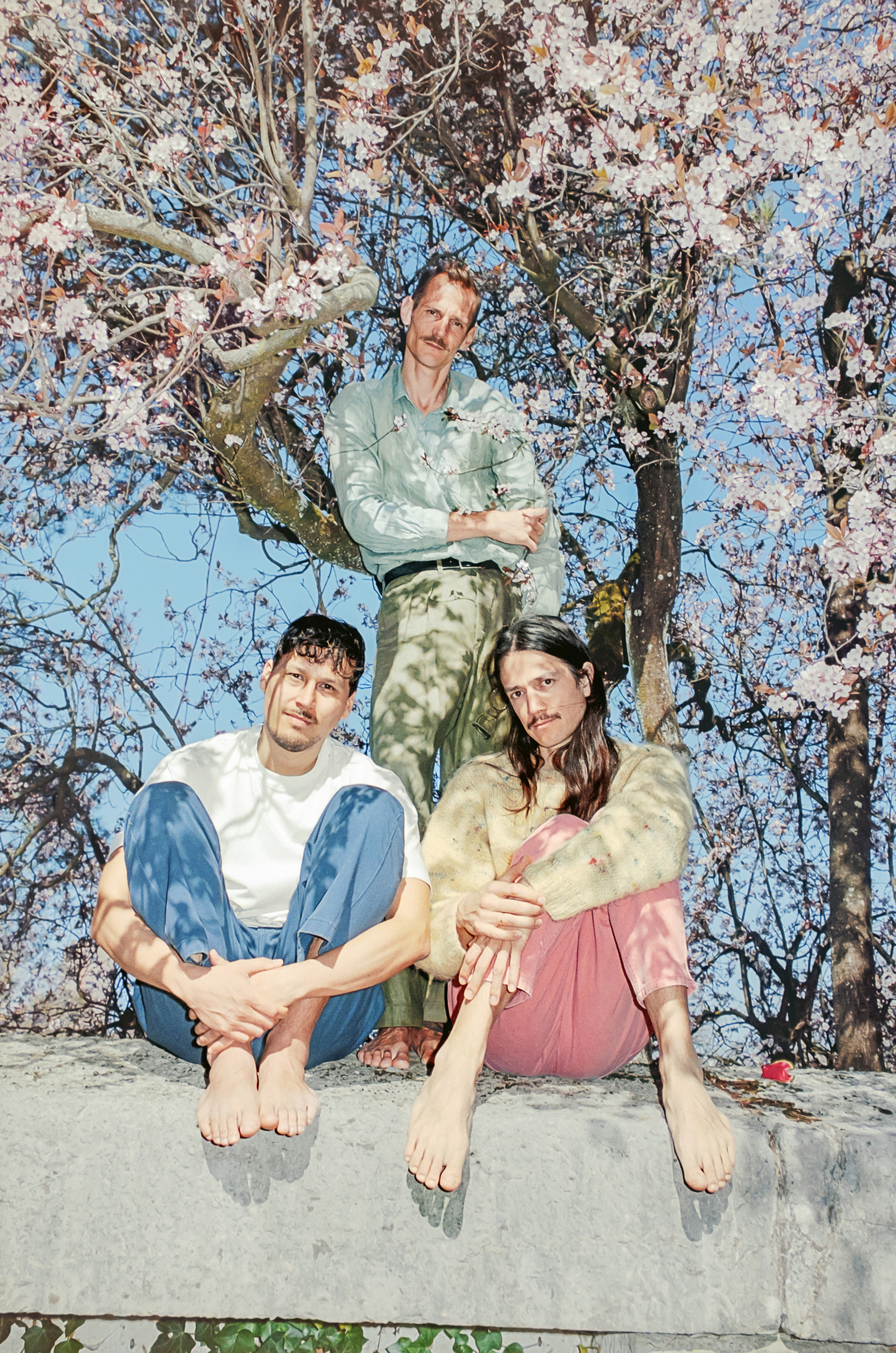
Löwenzahnhonig, the Zurich trio whose name translates to “dandelion honey,” make music that really does feel like honey for the ears. On their second record, Kirschblütenboogie, the guitar ripples like light across water, percussion hums in soft pulses, and each song drifts with a sun-dappled stillness that slowly turns hypnotic.
Liminul previewed Kirschblütenboogie before its September 19th release letting the record’s groove unfurl before connecting with the band to talk about how it came together.
The record opens with Zeithorizont, translating directly to Time Horizon. When you close your eyes and listen to it, it feels like when you’re laying still on grass as the day slips forward, the light shifting in quiet increments. There’s a moment when the guitar bends upward, the tone stretching until it wavers. It carries the same warmth as late sunlight on skin.
Summersurf drifts like salt air through an open window. It is one of the record’s highlights, a song that feels like walking toward a mirage in the desert. There is a faint western undertone at its foundation yet softened by a playful groove that blends genres with the ease of Löwenzahnhonig’s own signature touch.
View this post on Instagram
We caught up with the trio to talk about the spirit behind the album, their spontaneous creative process, and the beauty of instrumental music that leaves room for imagination.
How has the energy been in rehearsals as you get ready to take Kirschblütenboogie on tour?
Our rehearsals feel relaxed and curious. We focus on finding how the songs come alive on stage and on creating a feeling that connects us with the audience, so we can all share the music together in the moment.
I read somewhere that the band started from a spontaneous jam in Zurich. Do you still chase that same sense of discovery when you’re writing now, or has your process become more deliberate?
Our approach is still pretty much the same as at that very first jam in Zurich. We meet in our studio, start playing, and if it feels good, we record it and keep it as a sketch. Sometimes we finish arranging it right on the spot, other times we come back to it later and refine it further. But at its core, the process is still very spontaneous, free and open to any results.
Silence and space seem as important to the foundation of your sound as the notes you play. How conscious are you in deciding when or what not to play?
The magic really lies in the interplay between us as a trio, when we create that Löwenzahnhonig sound together. There’s a certain vibration, almost like a dance of tones and colors, that just arises in the moment. From the very first spark it felt special, and every time we play together, that same authentic Löwenzahnhonig sound appears again — where the notes and the silence find their place naturally in the interplay. It’s simply a joy.
The titles Fonduesandwich, Heavy Pink Snowflakes, Kirschblütenboogie are playful and surreal. Do the names shape the music, or are they after-the-fact reflections of a mood?
The titles usually come at the end of a session, inspired by something that happened that day when the song first took shape. For example, Fondue Sandwich came from a break where we went into a local shop selling cheese, and Paul, our drummer, joked that you could order a fondue sandwich — just bread with fondue cheese, not even melted. We found it hilarious, and the name stuck. Kirschblütenboogie came from the fact that the song was written on the very first day the cherry trees were blooming, and the track itself had a kind of boogie feel to it. So the names are often playful reflections of the mood or moment that surrounded the music’s birth.
Was there ever a turning point in any of the tracks, like a particular riff, rhythm, or accident, that made you realize, ‘okay, this is its own track’ which you could then build on?
That actually happened right at our very first meeting. Fai, our guitarist, and Simon, our bassist, had planned just to hang out and jam a little. Paul, our drummer, happened to be in the same room since he and Simon shared it. After chatting for a while, we sat down to play, and Fai started with this riff. We jammed on it, Paul immediately hit record, and before we knew it, we had arranged and tracked something. That track later became Winter Solstice — fittingly, because it was written exactly on the day of the winter solstice. It all felt completely natural and organic, and by the time we left, we already had this one track. That moment made it clear we had to do it again — the flow was so good that it quickly turned into a series of sessions, and eventually into a full record, our debut album Löwenzahnhonig.
Your recordings have a lo-fi warmth, almost grainy and tape-like. What choices did you make in terms of mic’ing, reverb, or mixing to achieve that atmosphere?
Most of the songs were recorded in the small DIY project studio that Paul and Simon run together in Zurich. Paul recorded and mixed all the sessions, and we’re lucky that he has such a strong sense of taste, shaping the tracks very much in his own style. For Kirschblütenboogie, though, most of the tracks were recorded in a rural barn, which gave the whole process a very organic, down-to-earth feeling — you could almost picture it like the back cover of Neil Young’s Harvest. The atmosphere was almost like recording in a living room, very intimate and close. We also tend to play very quietly when we record, which naturally creates that sense of space and air in the music, giving it a lo-fi warmth that breathes.
There’s been a wave of instrumental/lo-fi bands, Khruangbin, BADBADNOTGOOD, even surf revivalists. Do you feel like you’re part of that lineage, or do you see yourselves as operating outside of these genres?
We actually started shaping our sound quite independently of that whole wave of instrumental or lo-fi bands. Each of us brings our full musical background into it, which makes the Löwenzahnhonig sound something only we could create. Of course, we’re not operating outside of genres — language always relies on comparisons to make things understandable, so naturally people will connect us to existing bands. Honestly, the first time someone compared us to Khruangbin, we went and listened to them properly, and I think what they do is great. But at the same time, I feel Löwenzahnhonig has its own unique flavor that we personally find even more exciting.
If your first album felt like a captured jam, what’s the spirit behind Kirschblütenboogie?
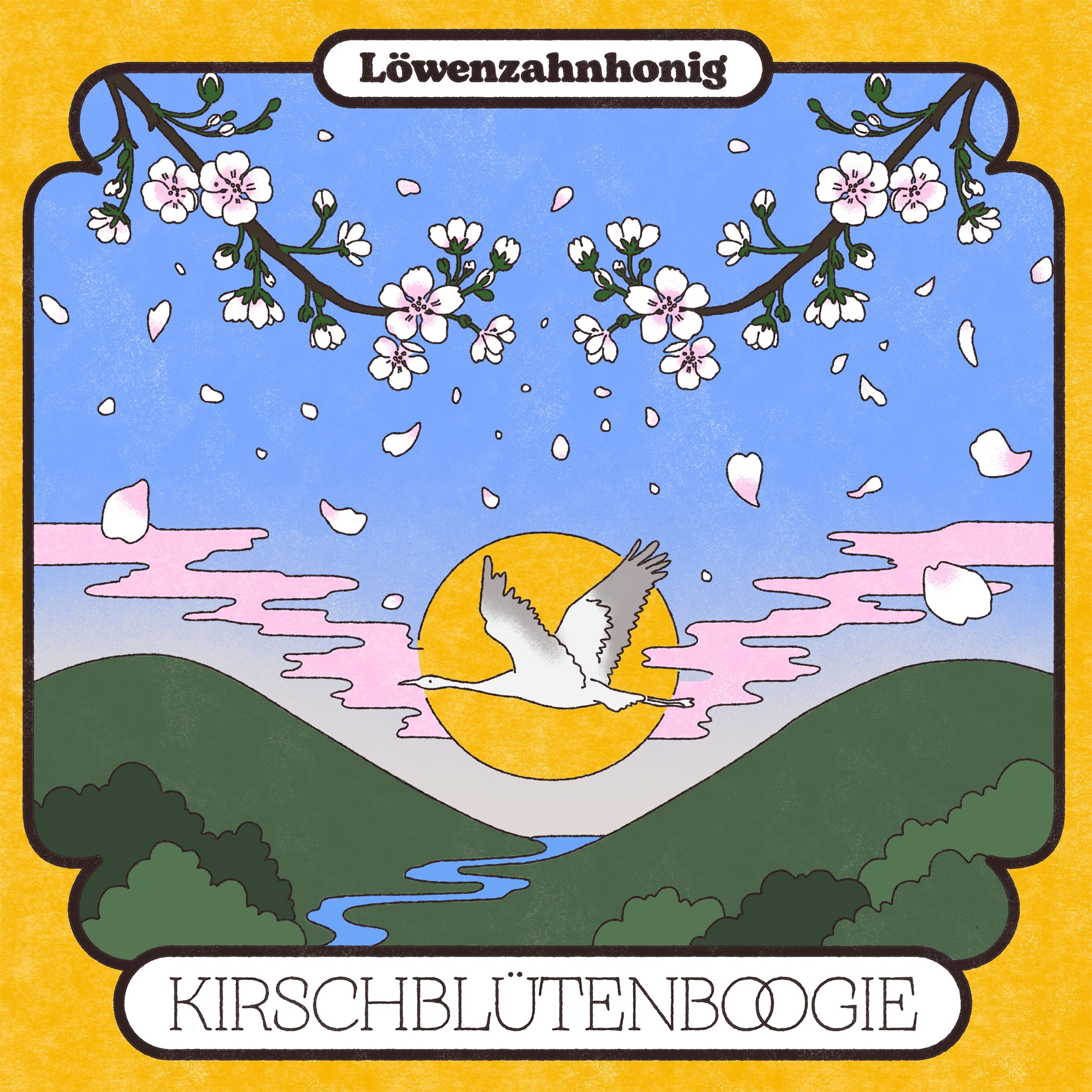
With our debut album, we were asked by our label to play two release shows, one in Zurich and one in Munich. That meant we had to revisit all the songs, rehearse them, and in doing so we discovered a new kind of joy in playing together as a live band, in front of other people. Out of that process came a spirit that is more playful, more alive. The songs on Kirschblütenboogie have a different construction, with more drive — they carry this boogie feel, these springtime blossoms, a sense of something new unfolding. The album cover shows a crane flying through the sun, which for us symbolizes hope and life. And we ourselves evolved from being a band that sat on chairs on stage to one that’s standing and swaying, giving the crowd more room to move and dance themselves. That uplifting, life-affirming, joyful energy is the spirit behind Kirschblütenboogie.
Löwenzahnhonig will take Kirschblütenboogie on the road this fall, with a run of dates that begins in Bern on September 19 and winds through Berlin, Paris, Amsterdam, and beyond before returning home to Switzerland in December.
View this post on Instagram
 Jenny is the editor-at-large at Liminul.
Ex-tumblr girl, flâneuse, art history grad, and staunch defender of the Oxford comma.