
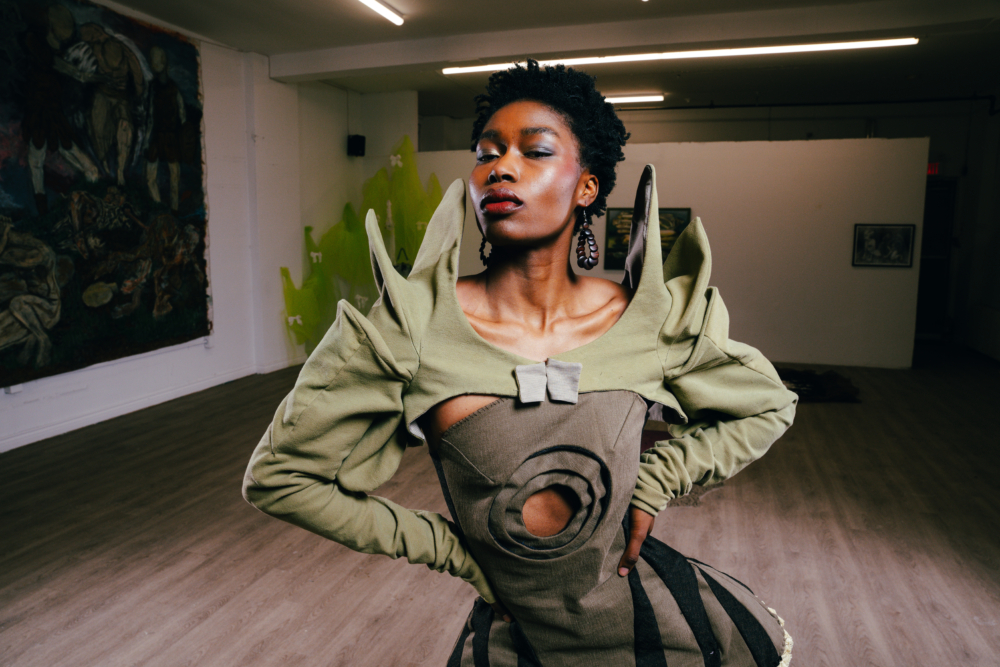
In a fashion landscape increasingly defined by polish, completion, and algorithmic refinement, Toronto-based ISECAI’s latest presentation proposes something far less resolved. Presented during their MACEL showroom this past February at MACEL Studios, “Metamorphosis” unfolds as a deliberately amorphous conceptual and sartorial statement.
Created by designer Caitleen Sicat, ISECAI has positioned itself since its inception as an evolving project rather than a fixed brand. While its earlier work drew from the excess and visual density of early 2000s maximalism, this latest iteration marks a shift inward, towards process, limitation, and the instability of identity itself. If previous outputs sought to define a visual language, “Metamorphosis” instead questions whether that language needs to be resolved at all.
At the centre of the presentation is a sculptural garment built around the idea of bodily transformation. A cocoon-like, caged skirt structure anchors the piece, developed through experimental pattern work and an engagement with unconventional construction methods. The concept preceded the form. “I wanted to implement it physically in the piece as it is, in nature, a bodily transformation,” Sicat explains. “It felt like a small metamorphosis of its own for me.”
What distinguishes the work, however, is not the garment itself, but the decision to resist presenting it as complete. Rather than concealing the stages of development, ISECAI brings them forward, foregrounding the process typically edited out of fashion presentation. Pattern experimentation, structural challenges, and unresolved elements become part of the final display, collapsing the boundary between making and exhibition.
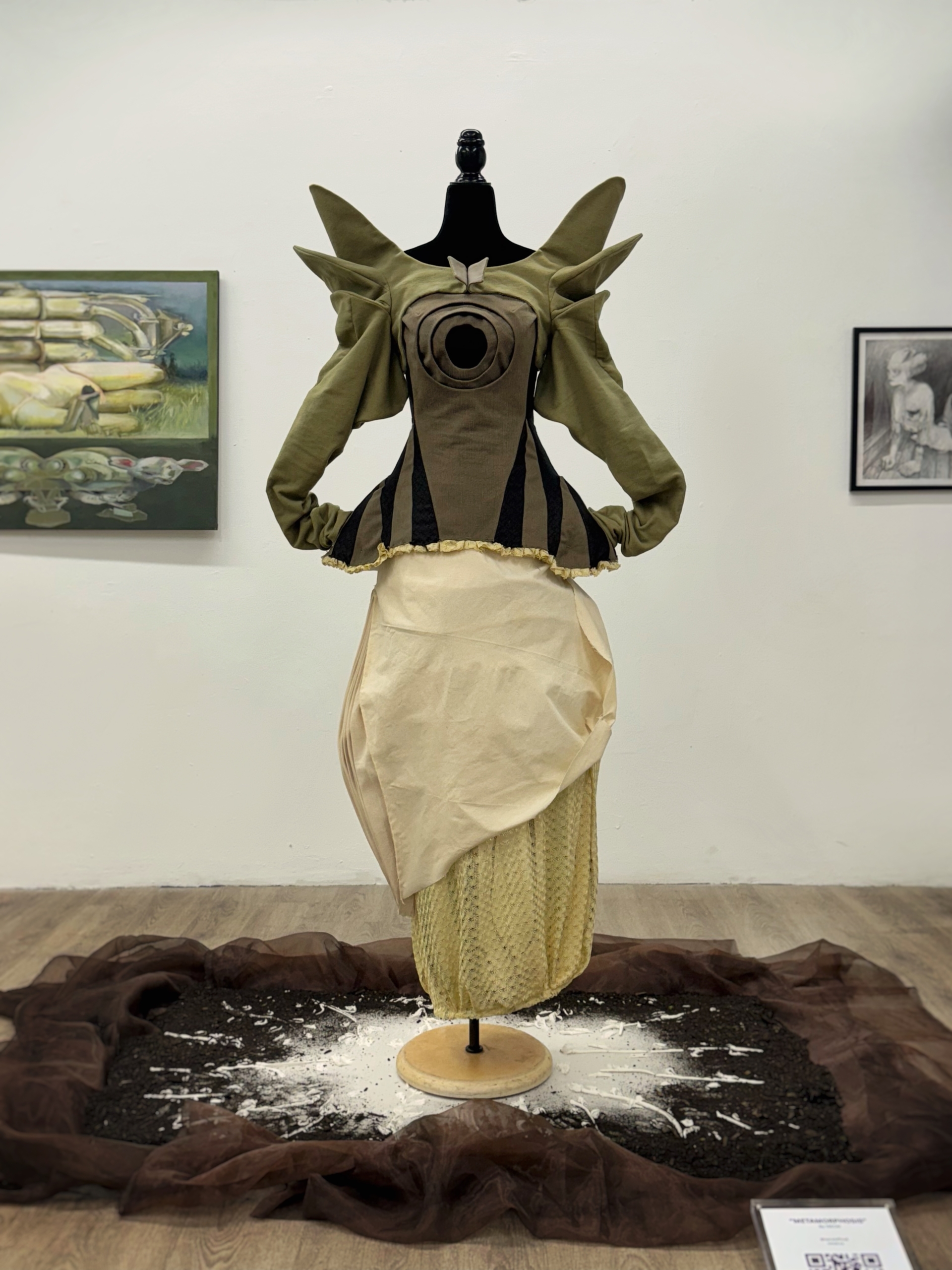
This gesture is not purely aesthetic. It is also practical, and more pointedly, personal. “It is a way of coping with my perfectionism,” Sicat notes. “It’s hard to showcase a piece I’m truly content with, so giving myself the luxury of saying it is ‘unfinished’ lets pressure off of me.” In this context, the artistic process is not provisional. It is the work.
The presentation extends beyond the garment into a controlled spatial and digital environment. Installed within MACEL’s showroom, the project integrates a projection-based animation developed in collaboration with 3D artist Katrina, reinforcing the central theme without overwhelming it. The space itself remains restrained, allowing the piece to retain visual priority while expanding its conceptual frame. As Sicat describes it, the animation “serves as a reinforcement of the ‘Metamorphosis’ theme and provides a larger idea into our vision.”
Alongside the installation, a retail component—The White Garden—offered a point of access to ISECAI’s core products. The dual structure of exhibition and commerce reflects the broader tension within the project: between object and idea, completion and process, visibility and construction.
If “Metamorphosis” marks a transition for the brand, it is not only conceptual but structural. As of April 2026, ISECAI enters an ongoing partnership with MACEL, gaining access to a physical space for production, presentation, and collaboration. For a practice previously shaped by isolation, the shift is significant. “Having access to a larger, well-equipped space and to be a part of such a positive community is what I was missing to progress,” Sicat says.
In positioning process as both subject and method, ISECAI resists the expectation that fashion must arrive fully formed. Instead, “Metamorphosis” proposes something less stable, and ultimately more reflective of the conditions under which it was made: a work in flux.
To see more from ISECAI, follow @isecaioffical and designer @caittrouble on Instagram. You can also view more from 3D artist Katrina at @katrina.designz.

Cody Rooney is the Editor in Chief and senior contributor at liminul.
He is a PhD candidate, digital content specialist, writer, editor, multi-media artist, and photographer.