
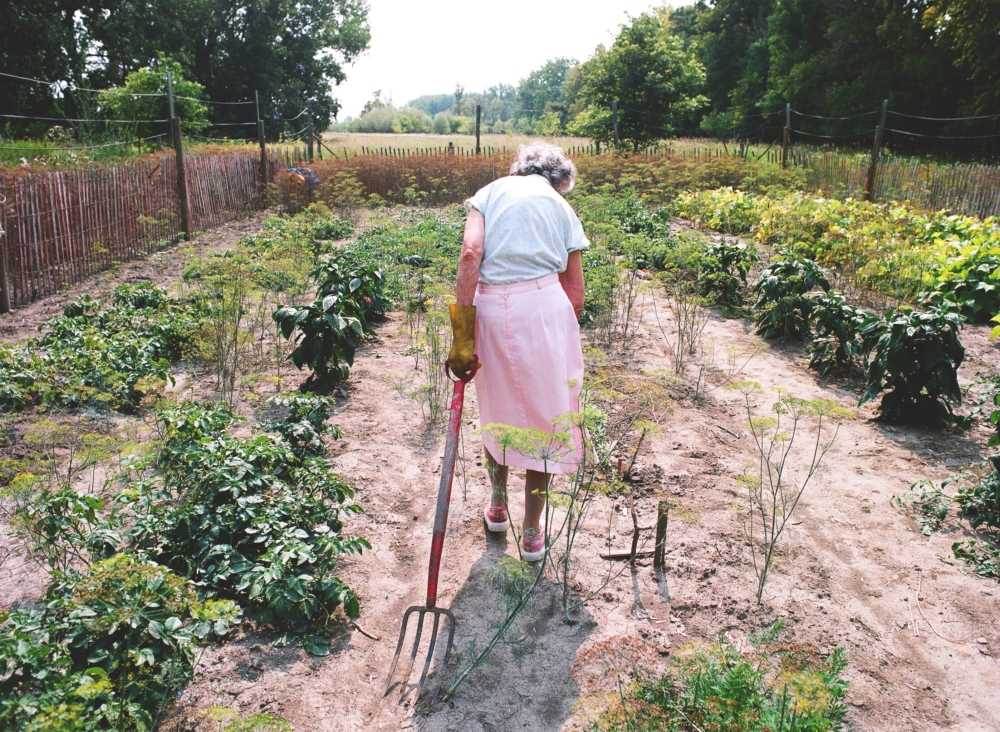
Upon first meeting Saskatoon-based director Amalie Atkins, I confess to crying, or rather sobbing, during the end credits of her feature film Agatha’s Almanac. With its Toronto cinema run debuting just prior to our call, I feel certain that Atkins is making time for me. It’s time, and the theme of time, in Atkins’ debut feature film (how we count it, how we pass it, how we value it), that the film leaves me with, yet it’s the very subject of Agatha on her farm that first springs tears to my eyes. Shot entirely on 16mm film over the span of six years, Atkins’ film, Agatha’s Almanac, opens us up to the rituals, the timekeeping, and the meticulous processes of Atkins’ dear Aunt Agatha, and Atkins allows us into this world not so much as voyeurs, but rather extended community, to witness as her aunt works and nurtures and harvests the land on her farm in Winnipeg, Manitoba.
My grandparents had a farm I used to go to every summer, I tell Atkins. We had to sell it in the near aftermath of the pandemic, I share, and witnessing the construction of Agatha’s meticulous almanac reminded me of something I had nearly forgotten about forgetting. My relation to Atkins’ film appears to be both a new and familiar story to her.
“I don’t know what’s going on, but I feel like I’m having really good luck with people that have a connection,” she smiles. “And I don’t know, maybe that’s why you chose to write about it, but even in Winnipeg, Agatha and I had a CTV interview, and the lady who interviewed us had a giant garden. Maybe it’s just that everyone has some way into the film. But it’s been really lovely because it feels immediately more homey when there’s a personal connection to the experience.”
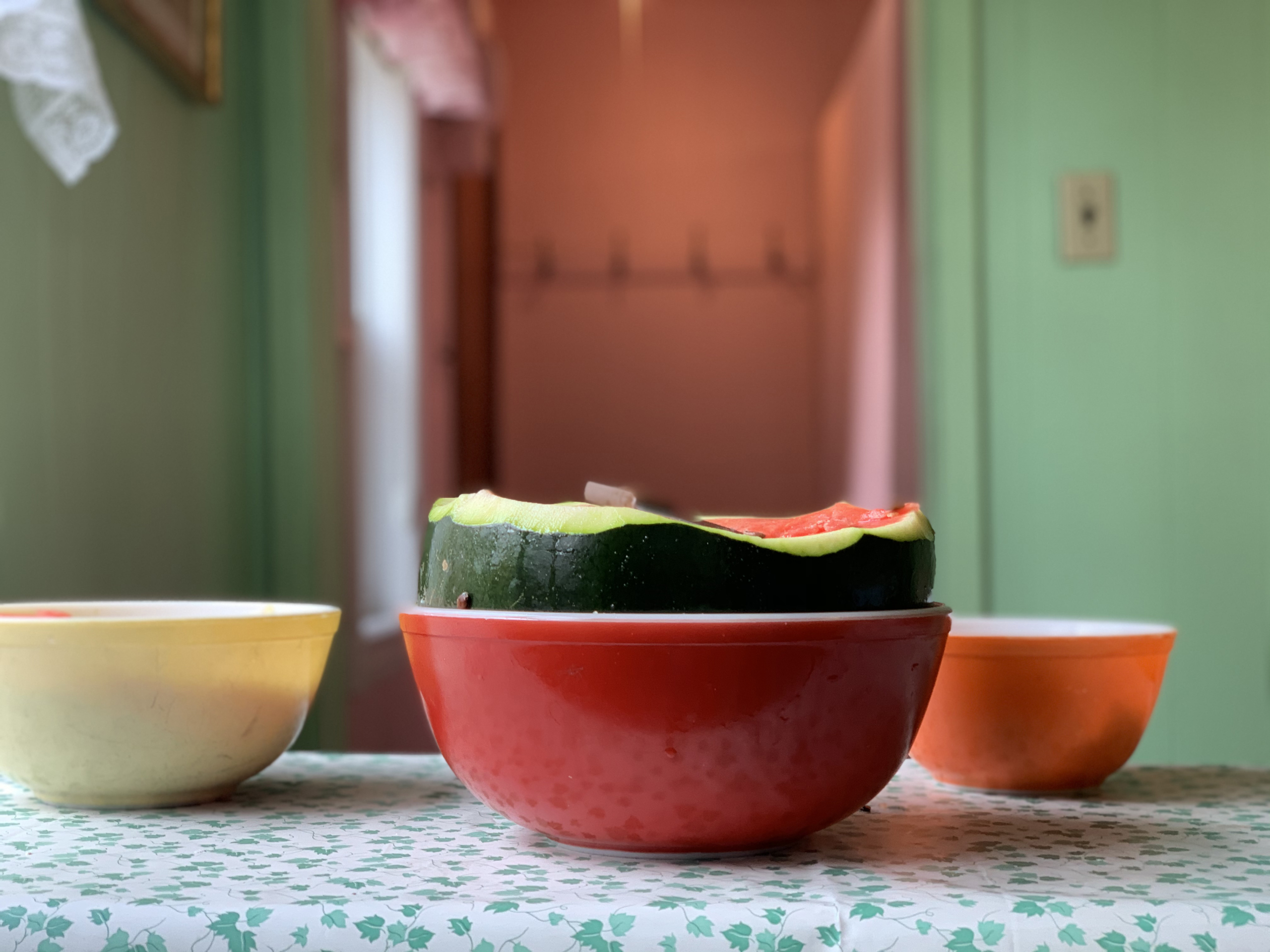
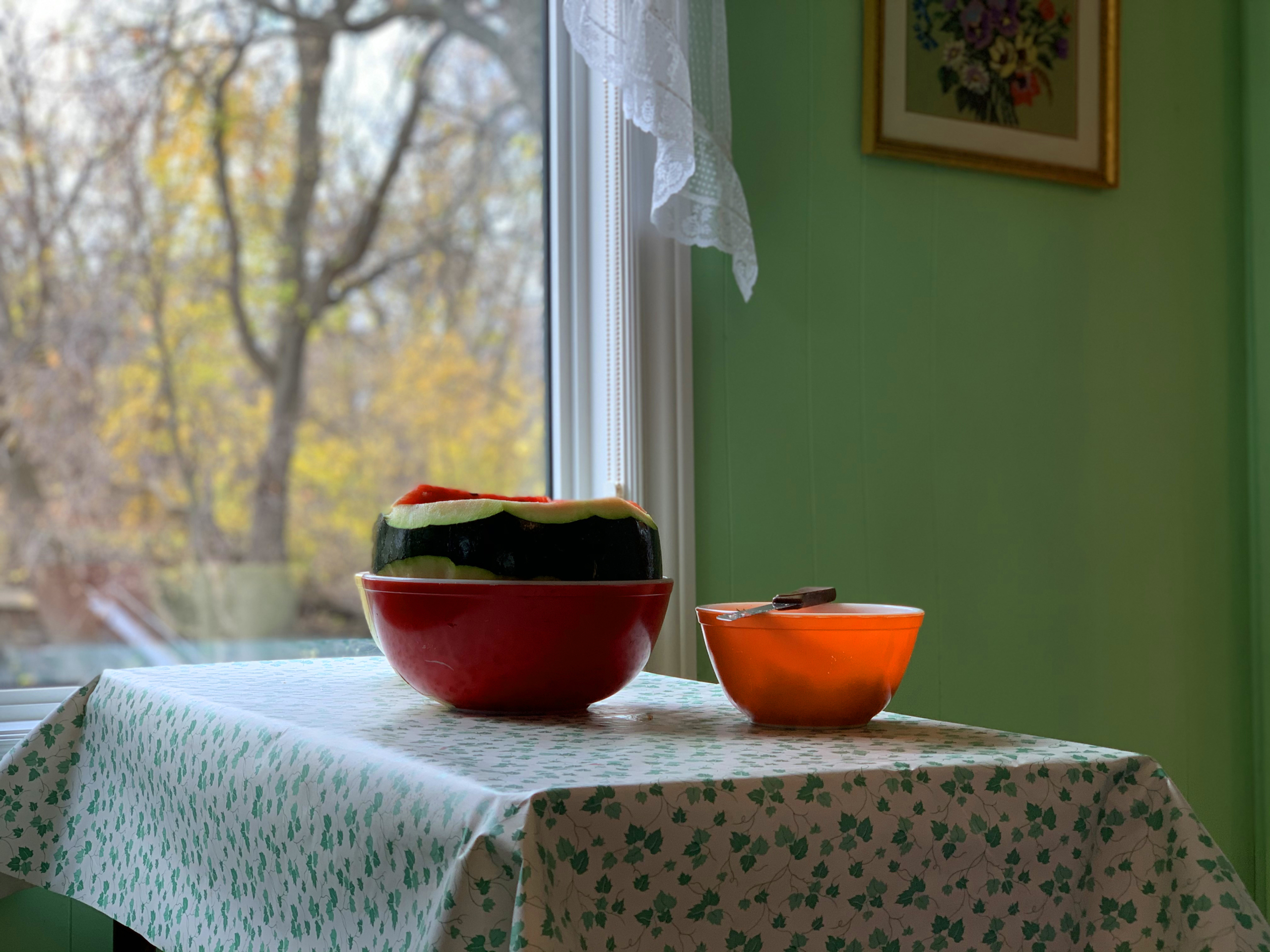
Homey is the most accurate descriptor of Agatha and her farm. Agatha’s world is whimsical and full of colour and patterns so vibrant and tauntingly rich, like bright red strawberries, freshly picked and carried in a lemon-yellow bucket. Atkins welcomes us to find peace and calm in a space that has meant just the same to her and her family for decades, and to have imparted on us the near 90 years of little wisdoms her aunt Agatha has gathered.
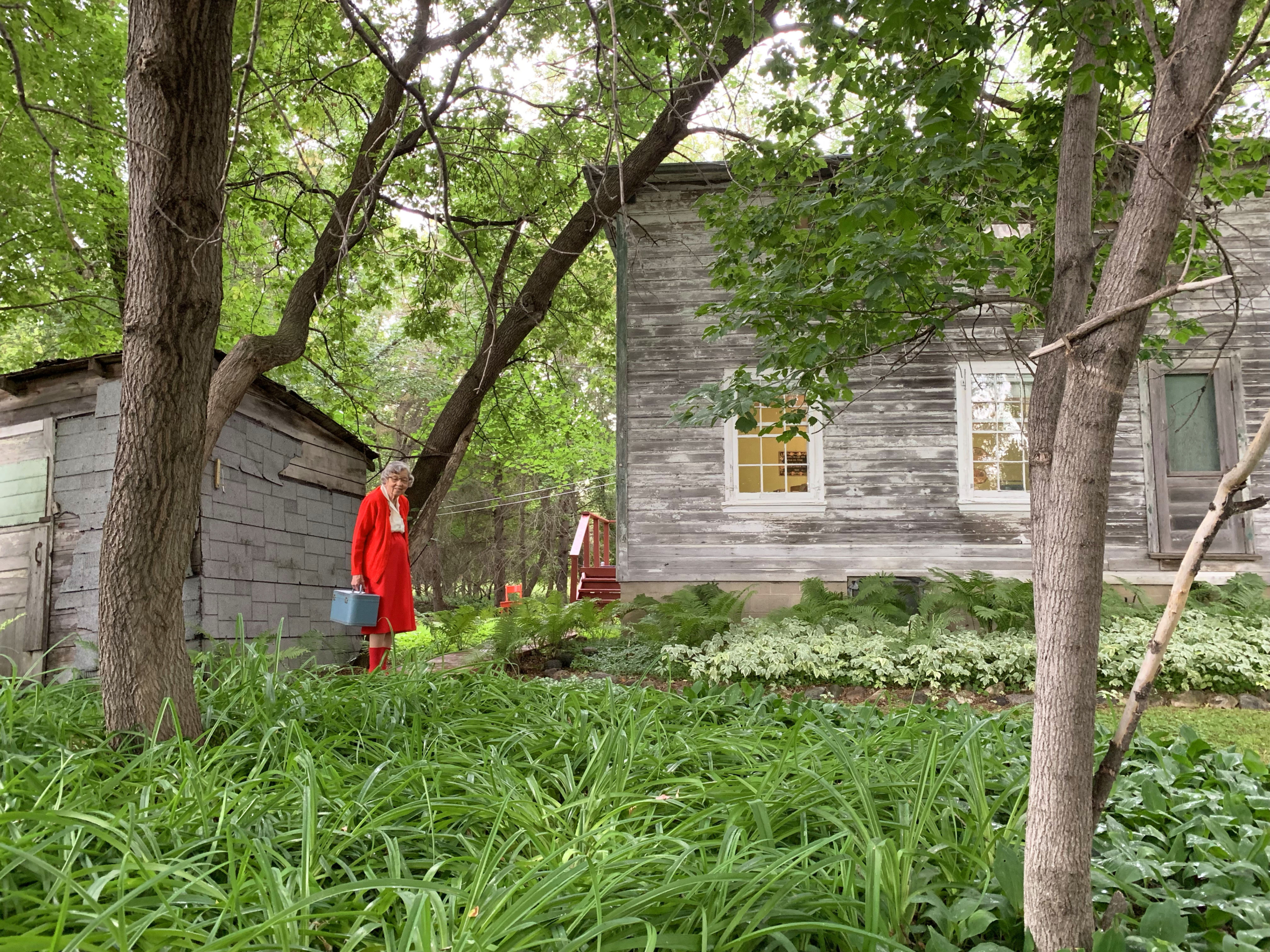
“I was trying to create something that would honour her. Also, it was a way to connect with her. That was really the main goal,” she shares. “Sometimes during the editing, I would think, ‘Oh, this could really be something. I think this could be like a cult film. Like with certain people, I think it will work.'”
Oftentimes, when we’re presented with stories that are antithetical to the cyclical hustle and loneliness that I, at least, can admit to feeling paralyzed against, we seek solution in slowing to a stop. What is so endearing, equally as challenging, about spending time with Agatha in her garden, is that this garden is not a place to rest. Agatha is insistent to do everything but stop, so much so that she claims to never have really felt loneliness in life as she always has something to do. Agatha shares about her lovers, about her losses, about the things she loves to do, and how much more she would do if she could, but that’s aging. She shares wisdom like how to properly store carrots in newspaper instead of paper towels, she uses duct tape to seal her windows, she picks flowers with a broken arm. She is resourceful, and knowledgeable, and stubborn in that knowledge. How shudderingly calming it is to watch Agatha charge forth at her full speed feels pointedly opposite of what we understand calm to be, and to be mesmerized by Agatha’s rituals feels inherently adverse to the confoundment of time that has amplified for many of us over the past several years, leaving us immobile and isolated.
“I was thinking about this the other day because releasing the film has been frenetic and stressful sometimes. It’s the opposite of being in this calm space in the edit at home. However, I am glad that it is reaching people all around the world. With the people who get it and appreciate it, there is a deep connection,” Atkins explains. “And I think it’s this connection to nature that is another one of the through lines, or the reasons why I made it. My own connection to Agatha and to my grandparents’ farm and spending time on the farm. I remember times hanging out with Agatha. After people went home, she was doing her evening gardening, getting her small tiny cucumbers. There’s endless material. And there’s so much to her life that it wasn’t possible to fit it all into this film. We’d be in the garden in the evening and she would be doing her thing. And I would be lying down recording the tiny little tendrils of the zucchini or cucumber plants. And she would be talking. It was just a very nice time spent together where she’s doing her work, I’m doing my work.”
Atkins dedicated six years to the filming of this project, meaning that how time is passed has changed a lot, for everyone it appears, except Agatha. We are more online, more remote, more indoors. Agatha continues to plant and tend and harvest.
“I had no idea if it would even be released in any significant way during the pandemic or even after. My goal was to finish the film. And I thought, if this film is a place for people to feel calm, that is one thing I want. Because I felt that every time I was in the edit,” says Atkins.
“I did some remote directing with Rhayne,” Atkins explains. Atkins would send the shot list to cinematographer Rhayne Vermette, who would then shoot remotely outdoors with Aunt Agatha to ensure safe procedure during the lockdown in 2020, and then send the shots to Atkins for editing. Some audio was also gathered remotely, with Atkins using an old messaging machine she has in her home to collect voice recordings left by her aunt. “The strawberry scene is completely remote directing.”
The strawberry scene follows Agatha to a strawberry field U-Pick to gather some berries. The colours are particularly dreamy, and the mirage of shots especially romantic. Layered on top, an edgy, alternative song called “Vidsutni” by independent Ukrainian artist Katarina Gryvul.
“I occasionally will do a deep dive on Bandcamp. That’s my go-to for music. I love supporting independent musicians. I mean, being an independent filmmaker, it only makes sense. Why would I do it any other way? I honestly don’t even know how I found it because it was buried in an album of a whole bunch of musicians. I found that song, and then I went to her album. She’s from Ukraine.”
The song at first feels juxtaposing to the style of film, but as we come to understand Agatha, it becomes clear how akin the song is to Agatha’s nature, and not just as an homage to her Ukrainian background.
“The edit actually changed originally. We had the strawberry scene where she’s putting strawberries in the jar and she’s trying to pick a fight with me. That was originally ahead of the strawberry picking scene,” Atkins reminisces. “So she’s picking this fight with me on camera. And then I had that song immediately after as my rebuttal to her trying to pick a fight with me. So it felt like, here’s both of our voices together. Here’s how I feel when you try to pick a fight with me. It was my way of standing up for myself without picking a fight with her. So I did use the music to show where my feelings might be at any given time.”
Aunt Agatha wears strawberry-red Vans with periwinkle socks and a blue dress speckled with yellow flowers while picking strawberries. Everything about what she wears stands out. She wears blue cable knit sweaters and black leather Chelsea boots. She wears pink tartan Keds, and ankle-length galoshes, furry ear muffs, and collared shirts dotted with little apples. She has a collection of 30 wedged shoes she got years ago for $15 dollars total.
“What she would wear was a collaboration between the two of us,” Atkins explains. “I kind of like to keep the myth of Agatha, but she likes to tell people, ‘I just wear a white shirt, my dad’s old white shirt, and these striped pants in the garden to protect herself from mosquitoes,’ but I said, ‘White doesn’t really work that well on camera, and you have all these great outfits. So let’s work with what’s in your closet.’ We would select outfits together. However, the color pairings and the shoes, it’s all her wardrobe.”
Though I’ve personally chosen to maintain belief in Agatha’s revolving, and ever chic, gardening attire, Atkins assures me that there were moments where Agatha’s inclination for her dad’s T-shirt and striped pants were overridden by Agatha’s authentic choice of brightly patterned outfit. One of my favourite outfits, Agatha’s bean harvesting outfit, with dark emerald corduroy pants paired with a magenta coat that has polkadots along the arms and crisp white sneakers, is an entirely Agatha creation, Atkins assures. “When I showed up, she had those green cords and I think it’s a purple blouse, layered with another color on top. She said, ‘Oh, do you want me to change?’ and I said, ‘No, what you’re wearing is absolutely perfect for this,'” Atkins recalls.
Agatha’s world is built upon pretenses that feel very singular to Agatha, but also so completely matter of fact. At one point, we are invited to learn about Agatha’s physical fitness routine where the fitness resistance bands are constructed by Agatha using elastic bands.
“We were so surprised, we had no idea. She told me that she does these exercises for physio. Her friend gave her the idea for these exercises from a physiotherapist, not her physiotherapist, so I asked if we could shoot them, but then she was getting really into making these rubber bands and I thought, ‘Wait, what’s going on here? You have to make the exercise bands first?’ In that scene she’s getting irritated with me that I wanted to shoot her making the exercise bands. She was like, let’s not waste time,” Atkins explains. “Sometimes you think it’s just the process, but then there’s the pre-process to the process. And so everything is intense in her life and the way she’s doing things. I think it’s really fascinating and interesting. She thinks it’s ordinary. So of course she’s like, this is not interesting that I’m making these, but to me, I’m thinking, ‘This is really great. This is really great that you have to first make the exercise bands.'”
With a story so personal and dear to Atkins, reliance on a team that trusted in her vision was paramount. To accomplish this, Atkins selected an all-women crew to bring her aunt’s story to life, choosing specifically to trust a team that reflected her subject.
“I didn’t really know exactly how it was going to go. We were often surprised by what Agatha was up to. I think having this team of women who really understood—they at no point questioned the process or questioned me or questioned Agatha on why we were doing something.”
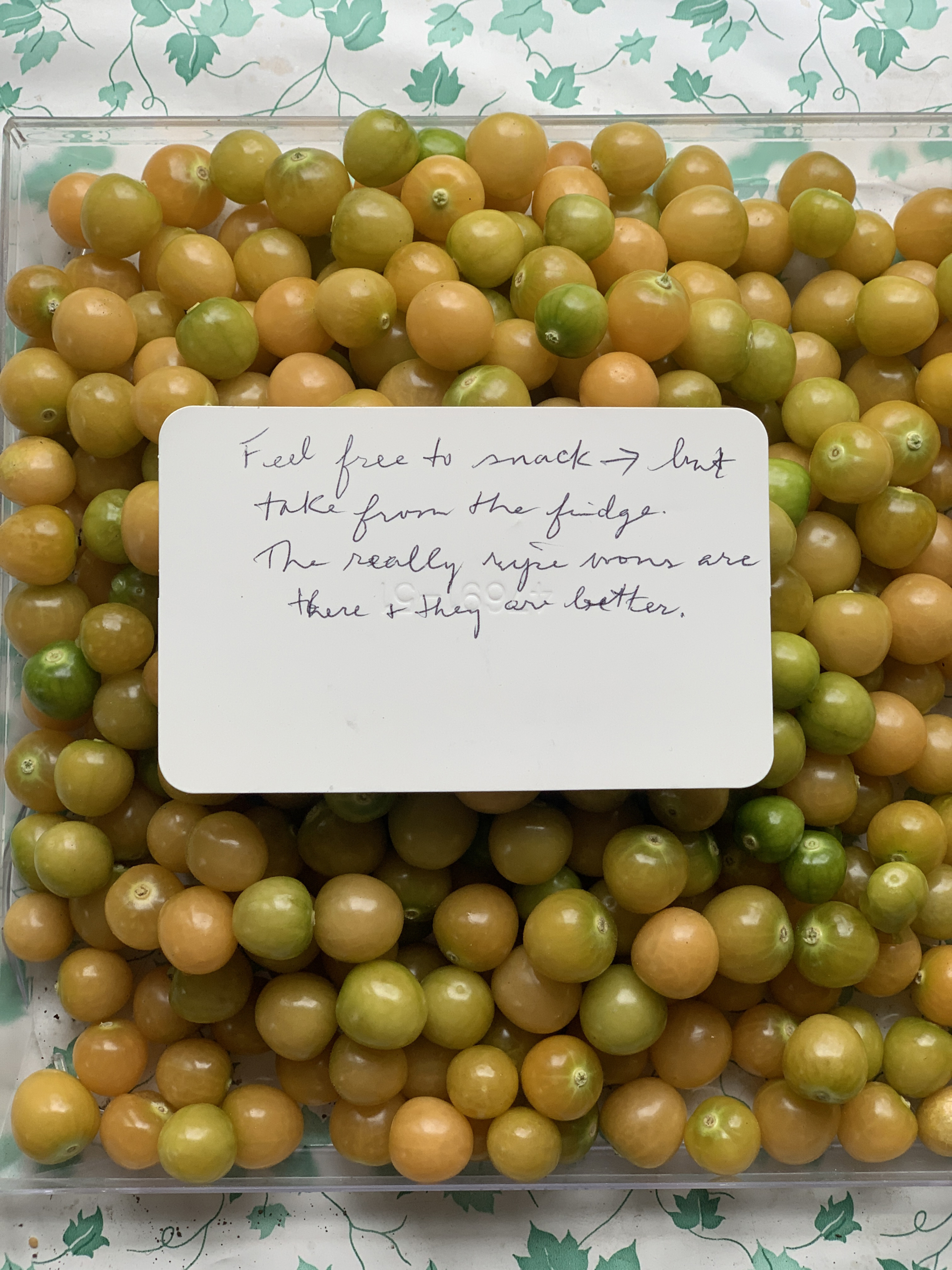
Though her team isn’t present on camera, there is often a feeling of gathering and community, a theme in Agatha’s Almanac. We never see the other members of her world, but we are privy to them. We see Agatha making perogies for family, we hear stories of the neighbours and her brother, we are told the seeds she uses in her farm are the same seeds used by her mother years ago. Most notably, we bear witness to Agatha’s community through her meticulous labelling and categorizing. Agatha labels everything with tape and black sharpie that reads something like, “good tub from anne leadbetter june 2003,” or like the fans labeled “very noisy fan” and “does not work.”
“I think the possibilities to keep working with her are there. Her urban life in her apartment in Winnipeg. She always has stories around her. She always has a story to tell. Every time she meets someone, she really connects with them. Anyone who’s done interviews with her seems to fall for her. She’s very generous in how she operates, generous with her storytelling, generous with food, generous with her time.”
With much attention, Agatha essentially categorizes the entirety of her world and those who exist in it in an incredibly tangible and visual way. How much that process inspires Atkins’ approach to this film versus what comes naturally to her as the niece of a woman like Agatha, we can’t fully conclude, but what is clear is that much of this film is its own catalogue of Agatha’s life in addition to a record of her almanac. In Agatha’s Almanac, we are all welcome in, not as omnipresent viewers, but as students, as neighbours, as witnesses.
“For me to have these witnesses of the crew, I think that was part of my desire to make the film, was to not feel alone,” Atkins shares. “To share Agatha with people, so even if the film didn’t show anywhere, having witnesses with me in Agatha’s world was also enough. It was enough.”
Agatha’s Almanac is showing in Toronto at the TIFF Lightbox April 3–9 and Hot Docs Cinema April 5 and 11.
It is also showing in Winnipeg at Cinematheque April 1–15, and in Vancouver at the VIFF Centre April 10–12, 14, and 16, and Lochmaddy Studio Theatre April 18 and 19.
Follow @agathasalmanac on Instagram for information on showings.
 Hannah Verina White is a Montreal and Toronto-based writer. She has a deep love for the melodramatic and nostalgic, both of which influence the way she writes and the subjects she chooses to write about.