When MEMU began painting sentences on walls in 2015, he wanted to leave something good behind for whoever walked past next. The Los Angeles artist has since brought his writing and wide-eyed characters to clothing, discarded objects and entire buildings, although his description of what he does remains fairly straightforward: make somebody’s day a little better. That can mean offering encouragement, but his sense of humour allows for stranger sentiments, too. “I hope I’m skinny enough to fit in the casket of someone I love,” reads one work, a declaration of affection with a decidedly morbid streak. “People think dark things and funny things and honest things, and I paint all of it,” he tells LIMINUL. “I’m not only painting comfort.”
A sentence usually begins in his journal, where he collects observations, quotations and things he hears people say. There is no immediate plan for every entry; some words stay on the page until he finds somewhere they belong. “I hear something — a stranger’s line, something that hits me — and it goes in the journal,” he says. “It sits there until a wall or a moment fits it, then it gets painted.” When choosing a spot, he considers the people likely to pass it, whether they will be rushing somewhere and what the surface looks like it has already been through. “A busy corner gets a sentence for strangers in a hurry; a quiet door gets one for the person who lives there,” he explains. “The spot always gets the final say on the sentence.”
That instinct also leads him towards materials other people have thrown away. Old doors and broken windows become places to write, with their condition helping determine what he puts on them. “I pick things that look like they’ve been through something — because that’s who the words are for,” he says. Across his portfolio, these found surfaces sit alongside street photography, paintings and clothing, documenting a practice that makes use of whatever is available. He is particularly fond of giving an object another purpose without concealing its previous life. “A thrown-out door already lived one life; putting a sentence on it gives it another one,” he says. “The object changes what I write, too. A sentence that belongs on a broken window doesn’t belong on a clean gallery wall. The damage is part of the piece.”
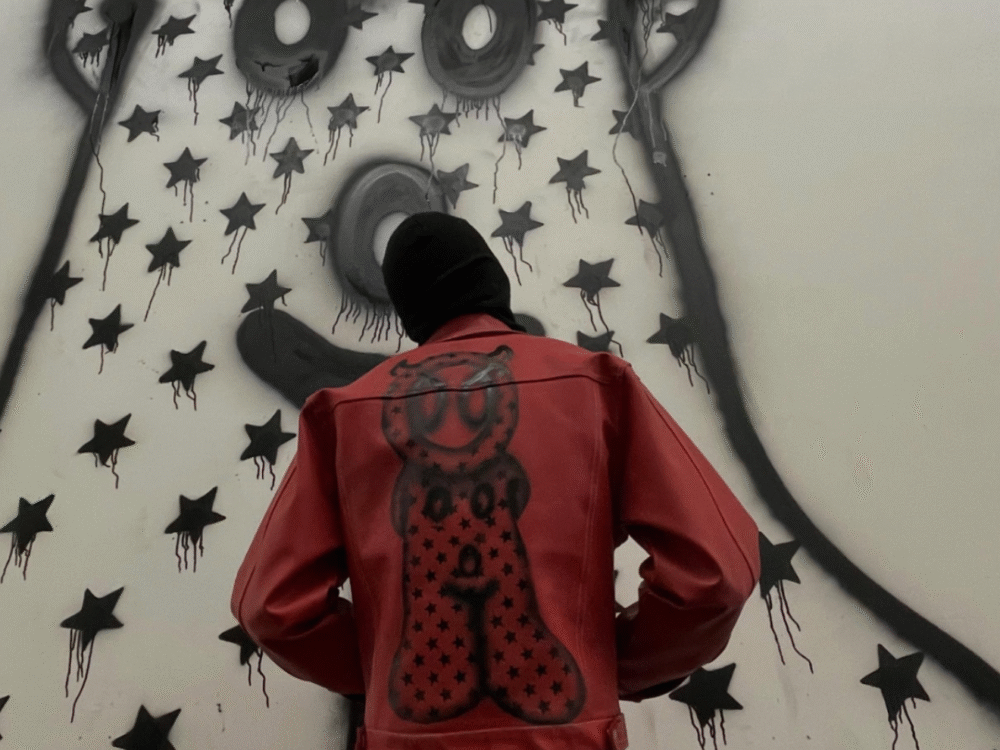
For an artist associated with positivity, MEMU is comfortable letting a message become uncomfortable. Asked about the casket line, he describes it as coming from the same impulse as the more reassuring things he paints. “The encouraging ones and the uncomfortable ones come from the same place — they’re just the truth said out loud.” His recurring characters are more openly welcoming, with large eyes and rounded bodies that appear across his murals and wearable pieces. He wants the face to register before the writing, giving someone a reason to look a little longer. “MEMU’s face is supposed to hit you before the sentence does — a hand-painted character that looks like it’s happy you’re there,” he says. “If the face made your day even a little better before you read a word, it did its job.”
The characters have also given him opportunities to work at a much larger scale. He recalls painting a giant MEMU across a building in Indonesia in January 2025, describing it as one of the biggest projects he has undertaken, and says he has painted walls in Paris and Japan as well. Photography keeps a record of these works and introduces them to people well beyond the streets where they were made. “The walls are the original — a hand-painted sentence on a street is MEMU at its purest,” he says. “The photography is how most people actually meet the work; the street is local, the phone is everywhere.”
For anyone who first encounters MEMU on Instagram, the photographs are likely to be the most familiar part of his practice. He documents everything he makes, although he maintains that the person walking past gets first consideration. “The street version is the real one: paint, scale, the neighborhood around it,” he says. Online, he is leaving the words with a considerably broader audience, many of whom will never visit the place pictured. “On the street it’s whoever happens to be there. Online, it’s anyone, anywhere, and the sentence has to hold up without the wall behind it.” He has also filmed strangers reacting to the work, and says the encounters he remembers are those in which somebody seems to recognize their own circumstances in a sentence. “They don’t just like it — they feel seen by it,” he says. “That’s when I know the piece did its job.”
Clothing grew out of people wanting to take some of that work with them. Under the name Tyler $tyle, he makes pieces featuring the same characters and messages, with hand-painted hats for strangers among his early experiments. “Same messages, same face, just moving through the world on a person instead of sitting on a wall,” he says. The appeal is partly in seeing where someone else will take it, and how they will make it part of their own wardrobe. “When someone wears MEMU, they’re carrying the message into rooms I’d never get a wall in,” he explains. “Designing for the body is different: the piece is moving, it’s on a person with their own style, so the sentence has to work while they’re living their life, not just standing in front of a wall.”
Some of those pieces demand a considerable amount of time: one pair of hand-drawn jeans took him 84 hours over seven days. His recent mural, Angels in the Grass, brings that same accumulation of small drawings to an interior wall, where two giant reclining figures lie beneath a painted sky, their bodies composed of hundreds of hand-drawn MEMUs. In photographs of the work, ladders and painting supplies give a sense of its size, while close-ups reveal the smaller characters packed inside each figure. It is the kind of project he is eager to do more of, building on a practice that people still largely associate with brief messages encountered on the street.
With a long-form documentary also in development, MEMU wants to introduce more of this work to the audience that knows him through his writing. “What I want people to see that they haven’t yet: the fine-art side at full scale,” he says. “The street quotes are how people know me, but the canvases and the big pieces are where it’s going.” In Angels in the Grass, the familiar faces have become the building blocks of something more elaborate, giving him room to work through an image over hundreds of individual drawings. He is enthusiastic about that expansion, even as his explanation for why he started remains modest. “The reason never changed: make somebody’s day a little better.”

Cody Rooney is the Editor in Chief and senior contributor at liminul.
He is a PhD candidate, digital content specialist, writer, editor, multi-media artist, and photographer.