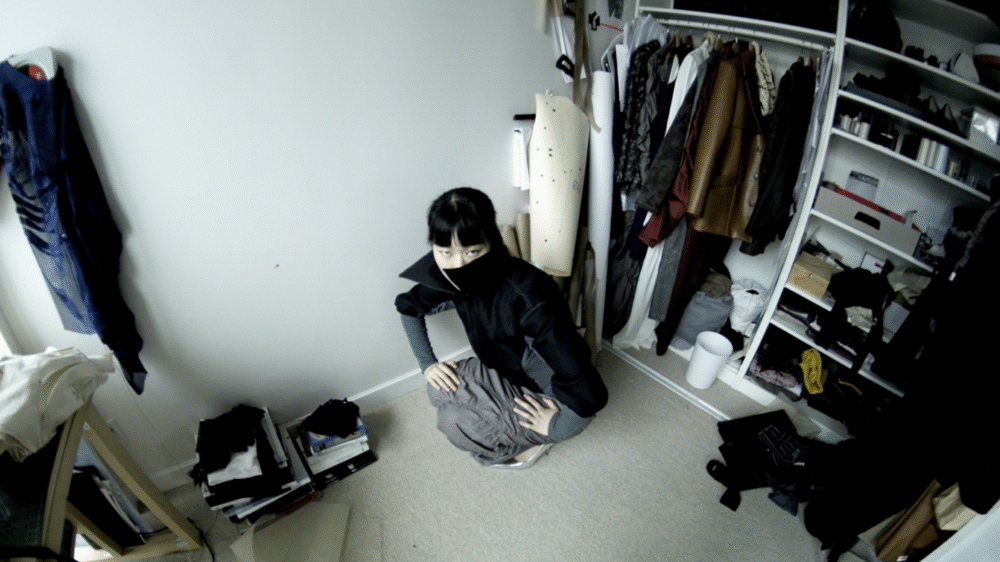
A little over a month is not much time to prepare an entire runway collection, particularly when every garment is developed and constructed by hand. But for Victoria Koniakhina, founder and designer of Toronto-based label NICHEGO, the opportunity to present at this season’s Toronto’s Own Fashion Week arrived at an opportune moment. Already immersed in the development of LA MUSE, a collection exploring the complexity of womanhood through historical, literary, and imagined female figures, Koniakhina decided to take the leap. On November 14, the collection will make its runway debut at TOFW, bringing together months of research, experimentation, and the painstaking work of translating an idea into something that can be worn.
Koniakhina has long approached clothing as a form of artistic expression, drawing on questions of identity, perception, and the relationship between the individual and society. Previous collections, including DUALITY and FUTEMOIRE, have explored these interests through unconventional construction, exaggerated silhouettes, and a willingness to experiment with materials. With LA MUSE, her attention turns toward the women who have occupied the imaginations of artists, poets, and composers across centuries. Among them are Isadora Duncan, the pioneering American dancer; Lalla, a 14th-century Kashmiri mystic poet; and Aida, the tragic heroine of Verdi’s opera. Their disparate histories and personalities inform a collection that resists any singular conception of femininity, instead finding expression through contrasts of delicacy and severity, vulnerability and strength. Sheer organza, distressed mesh, and intricate lace meet heavier fabrics and sculptural forms, with each look conceived as a character in its own right.
Fresh off her inclusion in Rebecca-Jo Dunham Baruchel’s exhibition at the Art Gallery of Ontario’s annual Art Bash, Koniakhina is preparing for what will be a significant moment in NICHEGO’s development. For an independent designer committed to slow production and an entirely hands-on creative process, staging a runway show presents both an opportunity and a considerable undertaking. Beyond the garments themselves, LA MUSE will unfold through choreography, casting, and an original composition by Toronto electronic musician Pete Standing Alone. Ahead of the presentation, LIMINUL joined Koniakhina during fittings to get a closer look at the collection in progress. In conversation, she reflects on the women who inspired LA MUSE, the realities of sustaining an independent fashion label, and why Toronto must begin recognizing fashion designers as artists in their own right.

To begin, can you tell us about the origins of NICHEGO? What initially inspired you to establish the label, and what were you hoping to contribute to fashion that you felt was missing?
NICHEGO started as a search for a medium through which I could best express my artistic voice. I’ve always seen myself as an artist, and the label allows me to combine different creative practices — from developing concepts around subjects that concern me to the constant problem-solving involved in design, construction, material selection, and garment-making.
I’ve always been drawn to exploring complex social, sociological, and anthropological questions, some of which are difficult to articulate through words alone. Fashion became a language through which I could communicate these ideas.
I suppose what I would like to contribute is a little more substance to fashion beyond aesthetics. I sometimes find myself missing that deeper conversation behind a beautiful image, and I’d love to see more designers use clothing as a way to explore personal, cultural, and social narratives.
Your previous collections, including DUALITY and FUTEMOIRE, have explored themes surrounding perception, identity, and imagined futures. What draws you toward these conceptual narratives, and how has your approach to translating them into fashion evolved?
As I mentioned earlier, I’ve always felt drawn to bringing attention to social issues and subjects that deserve a deeper conversation. I believe that, as an artist, I have a responsibility to communicate something that might resonate with or move someone.
With each new collection, the voice I express through clothing becomes more distinct. I’m still learning, of course, but I can already see a significant evolution in how I translate my thoughts and observations into visual language. In the beginning, I wasn’t entirely sure how to turn an idea or an internal urge to communicate something into an actual visual expression. Through constant experimentation and practice, I’ve become more confident in that process. The deeper I explore the subjects that interest me, the less afraid I become of expressing them through my work.
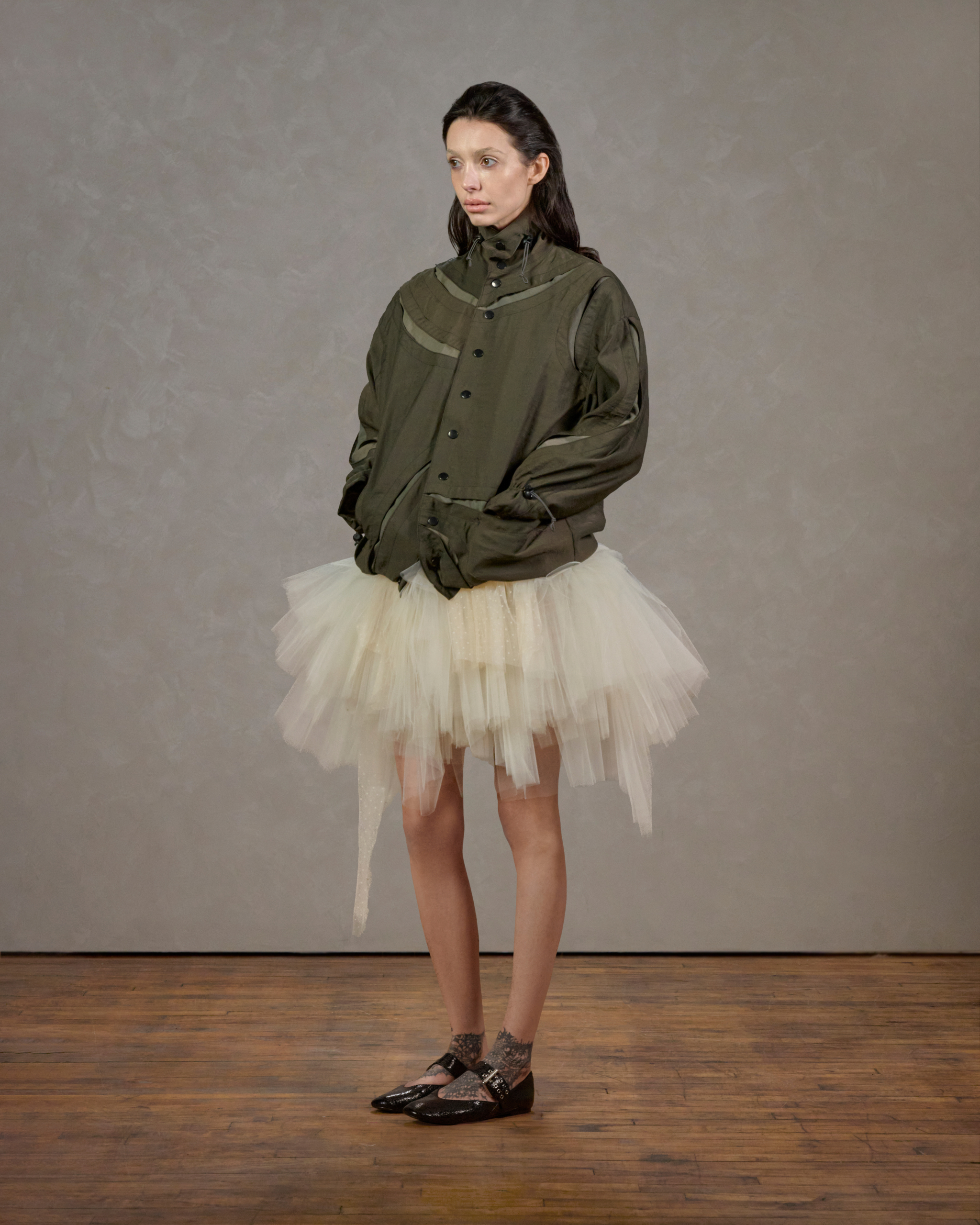
You’re preparing to unveil LA MUSE at Toronto’s Own Fashion Week. Can you take us through the story behind the collection? Where did the initial inspiration come from, and what ideas are you hoping to explore?
Participating in Toronto’s Own Fashion Week was actually a rather spontaneous decision. I hesitated for a long time, unsure whether I had the capacity to prepare for a runway show. By the time I committed, I had just over a month to complete an entire collection. Luckily, I was already developing LA MUSE, and several looks were in progress, so the timing worked out quite well — although there was still a lot to do!
The collection began with a period of reflection on the role of women in society, my own identity, and what it means to be a woman. This led me to explore different female figures who, throughout history, literature, and art, have served as muses or sources of inspiration.
Some are historical figures, such as dancer Isadora Duncan and Lalla, a 14th-century Kashmiri mystic poet and yogini whose poetry explores spirituality and the search for the divine. Others are fictional or more elusive characters, such as Aida from Verdi’s opera, a woman caught between personal love and a sense of duty, or Shagane from Sergei Yesenin’s poetry — a mysterious, distant figure wrapped in tenderness and nostalgia, whose very existence remains somewhat ambiguous. There is also the Lady in Grey, an imagined character of my own.
An important part of developing this collection was translating these different personalities into a runway narrative. I wanted each model to bring something of their own character to the presentation, so I paid particular attention to their individual presence, movement, and way of carrying themselves. They are all very different, each with their own energy, and that’s exactly what I wanted to emphasize.
For me, this is ultimately what LA MUSE is about: the complexity of womanhood. We can be gentle and severe, awkward and sensual, vulnerable and strong — often all at once. Women are incredibly multifaceted, and I wanted the collection to reflect that rather than offer a single definition of femininity.
But perhaps the best way to understand LA MUSE is to see it come to life on the runway.
One unexpected visual reference that accompanied my research was a book I came across in Paris, Snapshots of Dangerous Women by Peter J. Cohen.
How have you translated the collection’s central ideas into its visual language? Are there particular materials, silhouettes, or construction techniques that feel especially important to LA MUSE?
I wanted to create a sense of lightness and delicacy, while introducing a certain darkness and sharpness to the overall aesthetic. I experimented with sheer materials such as organza and mesh, sometimes deliberately melting or heat-distressing them to introduce a sense of tension and duality into the garments.
Another important element is the contrast between materials and textures — pairing delicate fabrics with heavier ones, incorporating lace beneath transparent layers to create volume and depth, and playing with silhouettes by emphasizing certain features of the body while exaggerating others.
Lace became one of the defining elements of LA MUSE. I used it in different ways: inserting it into garments, layering it on top, and even experimenting with printed interpretations of lace — something quite unusual for my practice.
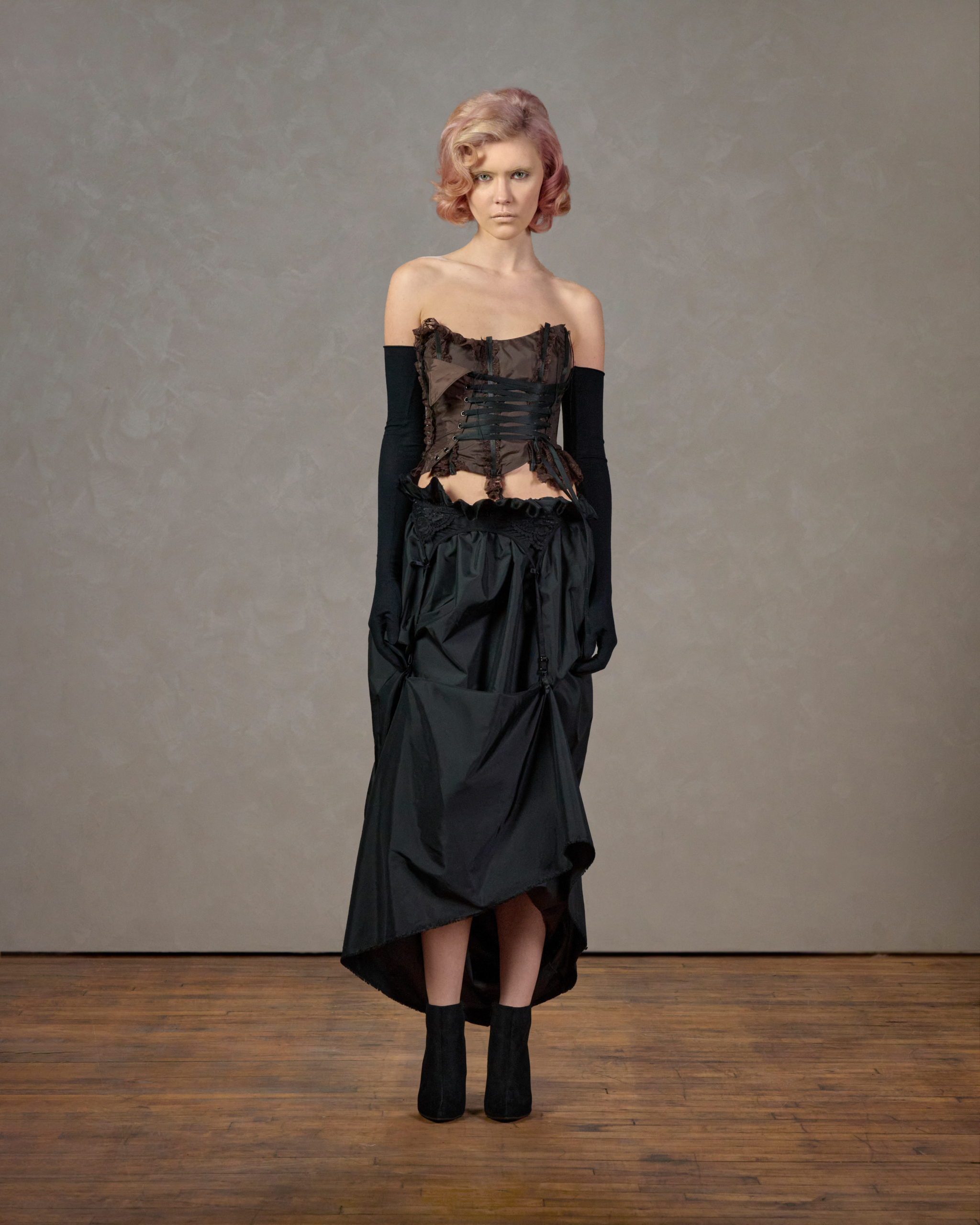
We had the opportunity to join you during the fitting process, which offered an intimate glimpse into the work behind the runway. How do your designs evolve as they move from concept to finished garment, and what role does seeing them on the body play in that process?
A lot of time passes between the moment an idea first appears in my sketches and the moment I finally get to see it on someone. There’s material and hardware selection, countless construction decisions, pattern-making, and endless adjustments to achieve the right fit. I would honestly love to spend even more time on these stages, but there are also seasonal deadlines and practical realities of the fashion industry to consider.
Sometimes, after working on a garment for so long, I almost get tired of looking at it. An idea that once seemed incredibly exciting on paper can start to feel less interesting, and I find myself repeating: “You just have to trust the process.”
But then comes the moment when someone puts the garment on for the first time, and everything changes. It’s difficult to describe the feeling. It’s almost like imagining characters as a child, drawing them on paper, and suddenly watching them come to life. Seeing my designs on an actual person gives me that same sense of excitement and wonder. It’s also the moment when I think, okay, maybe I actually know what I’m doing after all. Haha.
NICHEGO places considerable emphasis on craftsmanship, with garments handmade in-house and produced to order. How do you reconcile this slower, more intentional approach with the commercial and creative pressures of running an independent fashion label?
Running an independent fashion business is certainly challenging. The question of how to balance your creative ambitions with the practical need to make a living is something many emerging designers can relate to.
I recognize the importance of eventually scaling the business, building a team, and investing in better production facilities and processes. Ideally, these are things you invest in from the beginning, but unfortunately, I didn’t have that opportunity. Limited resources inevitably slow down the growth process, but with every season, I see NICHEGO moving forward, and I feel increasingly financially stable.
Alongside direct-to-consumer sales, working with independent boutiques on a consignment basis has become an important part of sustaining the business. I’m actively looking to build more of these relationships with retailers who genuinely support independent slow-fashion labels and understand the value of the work behind each garment.

I think it’s an ongoing process of finding balance — growing the business without losing the creative freedom and hands-on approach that made me start it in the first place.
Your work was recently featured at the Art Gallery of Ontario’s Art Bash, and now you’re preparing to present at Toronto’s Own Fashion Week in the historic Old City Hall. What does the runway allow you to communicate that other forms of presentation might not?
Both events are undoubtedly important for NICHEGO, but they offer very different ways of presenting work. An exhibition, such as AGO’s Art Bash, allows you to showcase existing garments within the context of a particular event, whereas a runway show involves a much more elaborate process — from developing the collection and its concept to casting, styling, music, and choreography.
One detail I’m particularly excited about is the original music created for the show by Toronto-based electronic artist Pete Standing Alone. After discussing the collection and its concept, we had only a few days to put everything together, and the result is a 20-minute original composition that I absolutely love and feel reflects LA MUSE beautifully.
Both experiences have also reminded me how important collaboration is. In both cases, I was fortunate to have people taking on a significant part of the work behind the scenes. For AGO’s Art Bash, Rebecca-Jo Dunham-Baruchel took care of the styling and overall logistics, while the RCHIVE team handled a large part of the runway production and coordination. Having this kind of support makes an enormous difference, especially when you’re working independently. I believe we’re all in this together, and supporting one another is essential to growing as a creative community. After all, every exhibition, show, or creative project starts with people.
Finally, what has your experience been like building an independent fashion label in Toronto? Where do you see the greatest opportunities and challenges, and what would you like to see change as NICHEGO continues to grow?
Building an independent fashion label in Toronto is certainly challenging. On one hand, I’ve found people here to be incredibly supportive and understanding of the realities of running an independent label, which is something I truly appreciate. On the other hand, I think there are still some structural and cultural limitations within the local fashion scene.
Having always looked towards European designers and fashion houses for inspiration, I’ve noticed a difference in how fashion is perceived and supported. In many European countries, fashion has a long-established cultural status and is widely recognized as an art form, with various grants and institutional opportunities available to emerging designers. In Canada, however, I’ve often felt that fashion designers are primarily expected to operate as entrepreneurs, rather than being recognized as artists in their own right.
As Toronto’s fashion scene continues to grow, I’d love to see a shift in that perception — more institutional support for emerging designers and greater recognition of fashion as a creative discipline.
I’d also love to see Toronto’s fashion culture continue to evolve and embrace an even wider range of aesthetics and approaches to dressing. I think there’s something very exciting about being part of a growing fashion scene, where there’s still so much room for experimentation and new perspectives. Through NICHEGO, I’d like to contribute to that development by introducing people to different ways of thinking about and experiencing fashion.
Cody Rooney is the Editor in Chief and senior contributor at liminul.
He is a PhD candidate, digital content specialist, writer, editor, multi-media artist, and photographer.