

After more than a decade in which watches seemed to get progressively larger, louder and more technologically ambitious, the most compelling thing a watch can be in 2026 might just be small. Not discreet in the bland, quiet-luxury sense, and not delicate in the way women’s accessories are so often euphemistically described, but genuinely tiny: shrunken to jewellery scale, half-hidden by a cuff or absorbed into a bracelet until telling time begins to feel like an incidental feature.
Of course, this turn towards miniaturization arrives at a moment when the practical function of a watch has never mattered less. Why strap another screen to your body when the phone in your hand already does the job better? Freed from having to compete with digital technology on its own terms, the analogue watch has returned to what fashion has always done best: turning an ostensibly useful object into a question of taste.
One only needs to look at how watches are being worn to see the shift. Timothée Chalamet wore two Mini Cartier Tanks at once, while Paul Mescal cycled through four petite Cartiers during the Gladiator II press tour. Pieces once confined to the dusty category of the “ladies’ watch” are moving freely across genders and dress codes, appearing with oversized tailoring, denim and eveningwear alike.
But what gives with the little watch in particular? The cocktail watch offers a useful historical reference, though its contemporary appeal has little to do with returning to the old rules of femininity or occasion dressing. Worn against an oversized jacket, buried in a stack of bracelets or left alone on an otherwise bare wrist, its smallness creates contrast, asking for a second look precisely because it refuses to take over the first.
The Small-Watch Edit
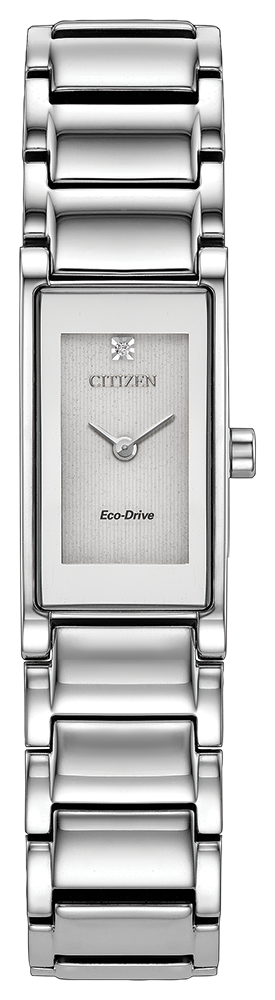
Axiom
Measuring just 14.4 mm, the Axiom’s silver-tone case nearly disappears into its stainless-steel bracelet, while Citizen’s Eco-Drive keeps the ultra-minimal design practical for everyday wear.

Classic
With an 18.5 mm burgundy dial set against a gold-tone expansion bracelet, the Caravelle Classic retains the familiar cocktail-watch shape while giving the form a bit more bite.
At the more conceptual end of this return to smallness, the watch is beginning to leave the wrist altogether. Piaget’s Swinging Pebbles suspend tiny dials inside carved-stone pendants, while Casio’s G-SHOCK Nano compresses its familiar digital square into a functioning ring. The two could hardly look more different, and yet both arrive at the same conclusion: once the watch no longer has to justify itself through utility, there is little reason for it to remain a conventional watch at all.
Citizen’s Fio and L Rainell bring that logic back to a more wearable register. The Fio uses a deep red leather strap to frame its compact case, while the Rainell folds an oval dial into a gold-tone bracelet so completely that it becomes difficult to tell where the jewellery ends and the watch begins.
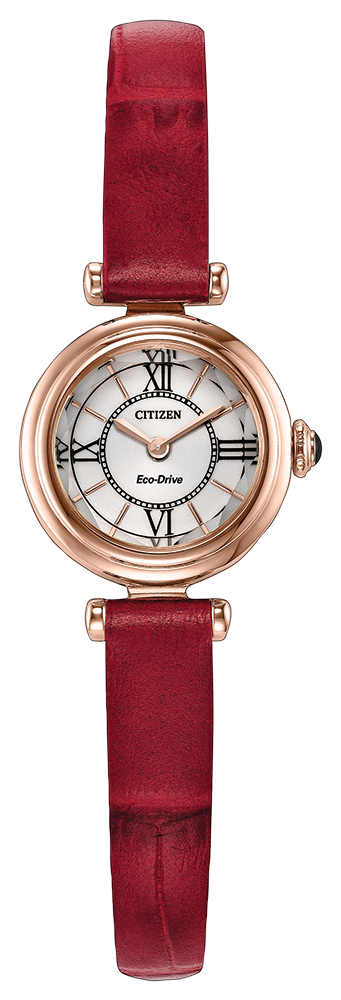
Fio
The Fio pairs an 18.4 mm rose-gold-tone case with deep red leather, using the sharp colour contrast to keep its compact geometry from feeling overly delicate.
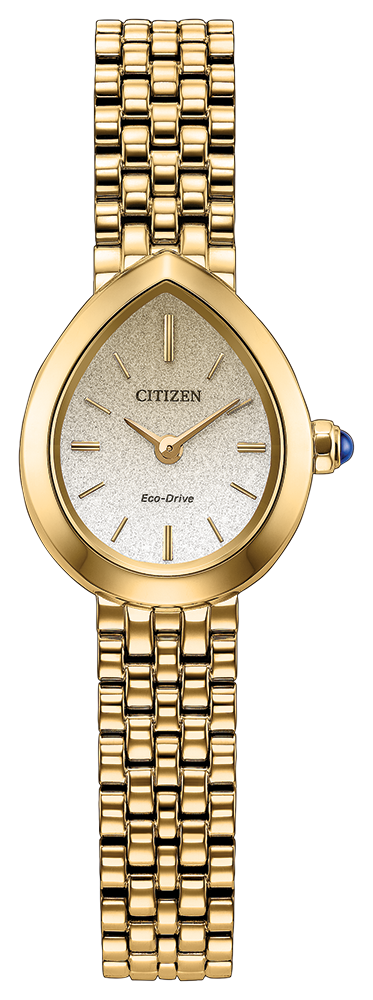
L Rainell
Set within a finely linked gold-tone bracelet, the L Rainell’s 20 mm oval case makes the watch feel less like an added accessory than part of the jewellery itself.
Perhaps that is the real appeal of the little watch: it does not disappear so much as change the kind of attention it demands. You notice the line of the bracelet, the flash of a dial and only then the time itself. In a fashion landscape where accessories are so often designed to announce their value immediately, the little watch withholds itself. One thing is for sure: it is no longer simply there to tell the time.

Cody Rooney is the Editor in Chief and senior contributor at liminul.
He is a PhD candidate, digital content specialist, writer, editor, multi-media artist, and photographer.