
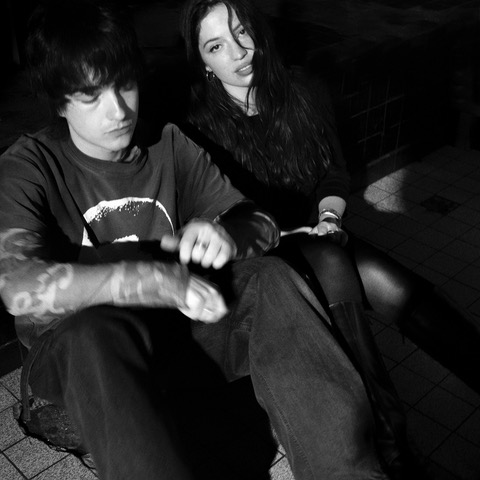
Divine twins and duos of all kinds are scattered in mythology and fantasy from various cultures throughout history. Primordial pairs are often the core of creation myths; seeing two different beings unite their efforts to create a new entity.
The creation story of Alaska Reid and Dylan Fraser joining together for Witch Post is one such tale that parallels the primordial pairs littered throughout folklore. Coming from solo artists backgrounds, they now complement each other from opposite corners of the world. The two fill the geographic gap between themselves by creating a universe that ties their cultural differences with magic from mythology, with Reid’s roots in Montana and Fraser’s in Scotland. Butterfly, their 2026 EP released under Partisan Records, progresses their lore further.
Reid and Fraser’s contrasting vocals intertwine throughout all of Witch Post’s developing discography. Pub-rock influence hails from Fraser’s end of the spectrum, while Reid’s tinges of alternative-folk assists in piecing them together. Their cross-continent working relationship is thought-provokes those they enchant, though it only directs to their project’s focal point. “An important thing we’ve been circling as a band is explaining what links people and different cultures is the imagination, stories, and fantasy that exists within each thing. If you study things, you find that all of them trace to all these different places,” explains Reid. That central goal is exemplified in the title of an unreleased song ‘Manticore’ – a creature they learn from research [after Fraser titled the song] originates from Persian mythology and shows up in medieval lore across the world.
In finding common ground between themselves and the numerous cultural standpoints they stitch together, Reid and Fraser assimilate the similarities and differences in folklore to discuss real life situations. “We did this on the song ‘Changeling’. There’s a real person behind this, but we refer to them as a changeling, a fey creature that’s been swapped at birth,” Reid remarks.
Between the dialogue folded into their lyrics and rich visual world, the duo bridge traditional folklore from Scotland to Montana into a unique perspective that offers a pop-like accessibility and conjoins them as songwriters–rather than writing solo for the band. Reid and Fraser’s intertwined songwriting allows their melodic conversations to take on different forms and entities, such as the inner dialogue between consciousness and anxiety on ‘Worry Angel’.
“We both enjoy something that feels conversational to whatever extent,” adds Fraser, “It feels like a free flow of consciousness. When you’re waiting for the next line because the song has brought you there, it’s like reading a book and you’re trying to find the next line or page. That’s what conversation is to me. I think The Waterboys do it really well – you’re listening to every line and word that he says because there’s something compelling about the way it’s done. We’re always looking for things like that.”
Witch Post combines Reid and Fraser’s myriad of interests into a brief that takes a less diaristic approach compared to their solo writing. “A lot of times [as a solo artist] you end up writing diaristic songs. That’s really cool, but I’ve been doing it for 10 years. I wanted to have a twist on it and find different places to write from. It’s still very much diaristic in a way, but hidden between layers,” observes Reid. Exploring where they can find common ground, even when observing stories outside of their lived experiences, has been a special pursuit in their writing. “There’s songs that might be about a friend of Dylan’s or someone he knows. We’ll have a really deep discussion and find a way to write about it in a way that makes sense to both of us,” Reid continues.
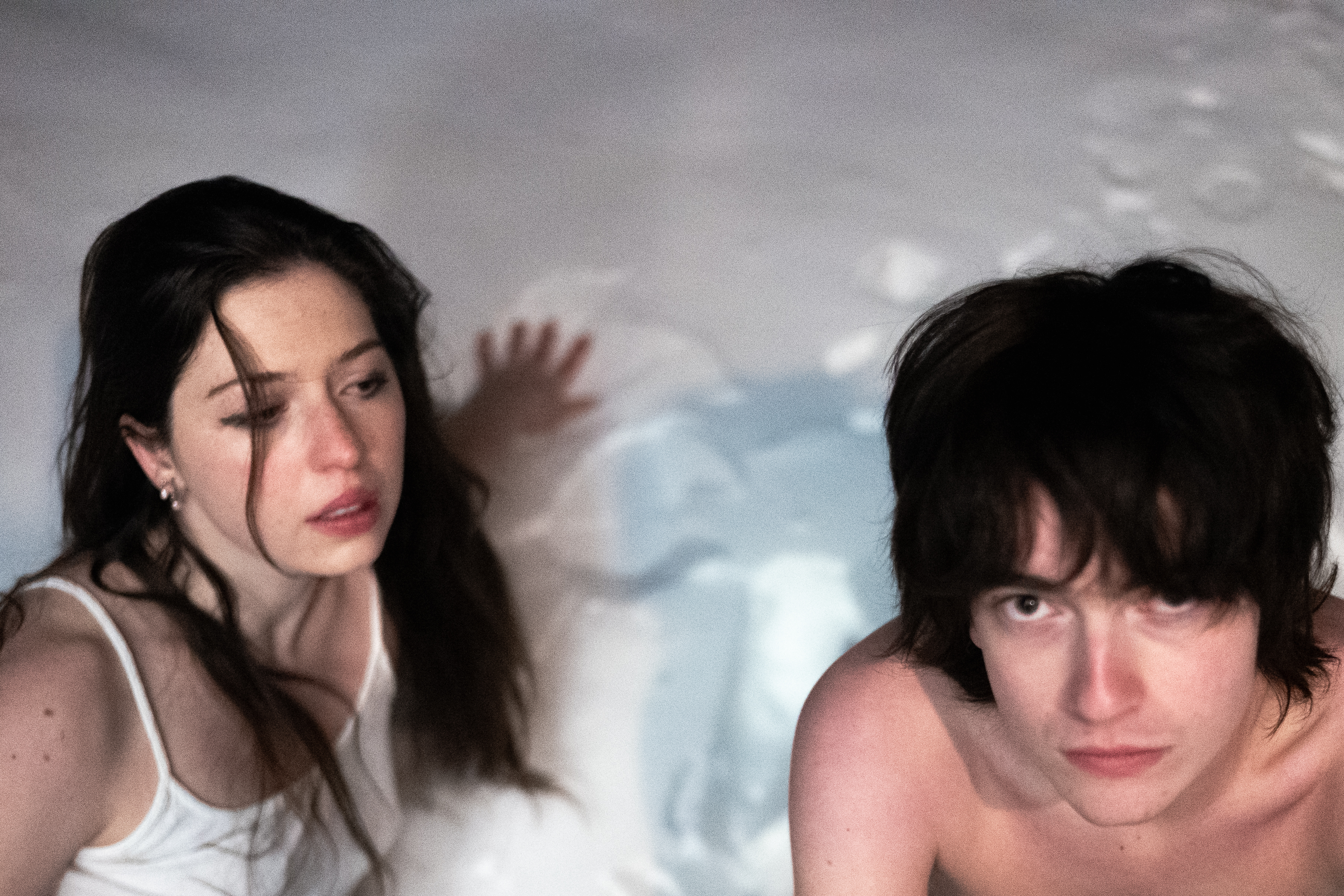
Blending these lived-in experiences with their interest in mythology produces the ethereal, dream-like storytelling within Witch Post’s work, deepening the imagery from their different imaginations. Reid’s encyclopedic knowledge of fantasy books meets Fraser’s ambition to spearhead bringing compelling visual ideas to life, with the help of their friend Lara Laeverenz. Fraser’s work isn’t unrecognized; Reid intentionally expresses gratitude for the lush visual landscape he produces. “[The videos] add a whole other dimension to a lot of the songs in the EP.”
Tapping into fantasy fits hand in hand with the magic that the pair carry in their friendship. It’s a magic trickling into the world they’re building as Witch Post; tracing back to their meeting when Fraser found Reid’s music, and the day they decided to become a band after initially denying its calling. Writing music with a magical edge is a natural choice, here, for a convergence that feels like fate. That magic translates to listeners – permitting an ability to escape and immerse themselves into a surreal reality.
Witch Post’s portrayal of escapism acts as a relief to understand how to move through existence, a notion that Reid seeks in her form of it. Escapism, to be sure, could be essential to a band immersed in fantasy, yet listening to their work, one can’t help but connect to their inner emotions and allow them to cross into reality.
Fraser particularly mentions that experience as an objective for the music he listens to and puts out. “When music, art, or any outlet brings joy, inspiration, or another sort of emotion, it’s a good thing. When I listen to a song, even when it’s inherently sad or dark, I find myself feeling emotional in a way that feels optimistic. You could be crying or you could be moved, but not sad. It makes me feel hopeful. Feeling seen by a piece of art or music is the end goal.”
The duo allows escapism to play into their lives both in and outside of Witch Post, leaning into it as an intentional way of being. “Escapism is what you have to do to be a better person. Engaging in art, engaging in things that people are making – making stuff in general is just cathartic. It makes you feel like you’re putting something good into the world,” affirms Reid, emphasizing its importance in a complicated, dark world; where social media and phone usage overall can make it difficult to thoughtfully engage with art. “I’ve been leaving my phone at home when I go for a walk. I used to always listen to vinyl in the kitchen while I’d cook because I would listen to a whole album. Spotify is so accessible, you can skip from song to song. I think somewhere along the way, it’s actually stopped me from listening to music,” agrees Fraser.
Absorbing art in their own ways has only allowed Reid and Fraser to better learn from one another, especially transitioning from solo to duet work. Writing as a unit became a hands-on experience to learn compromise. “You come with different priorities or ideas that come together and you have to figure out, “How do we do what’s best for this song? How do we feel both involved and a part of this?” says Fraser. The results have proven themselves fruitful; the band are working on their debut album and, in doing so, find themselves weaving into each other – sharpening every melody and gaining mutual understanding of each song’s DNA.
The synchronicity between both counterparts is apparent while their careers progress. Growing alongside each other in Witch Post poses the opportunity to navigate their solo careers with a newfound freedom and clearer direction – when the time is right. Seeing both Reid and Fraser’s efforts work in tandem to captivate audiences feels magical; similar to the divine figures found across mythological histories. Collaboration and compromise, in lieu of conflict, carries the creation story of Witch Post, as this primordial pair continues to expand their mythical universe.
Izzy Petraglia is a publicist, writer and photographer based in Toronto. Within her work, she loves to tie in her passion for music, fashion, and pop culture. Follow her on Instagram.