
Contemporary image culture is often described through excess, whether through Guy Debord’s conception of the spectacle, Jean Baudrillard’s simulacra, or contemporary discourse surrounding the endless recursive circulation of algorithmic media. Much of our media scholarship surrounds the pervasive inundation of our hyper saturated media landscape. Walking through the new spring season at MOCA Toronto, what becomes striking is not simply the overwhelming quantity of images, but the gradual collapse of distance between the image and the spectator themselves, and the collapse of stable references within these images.
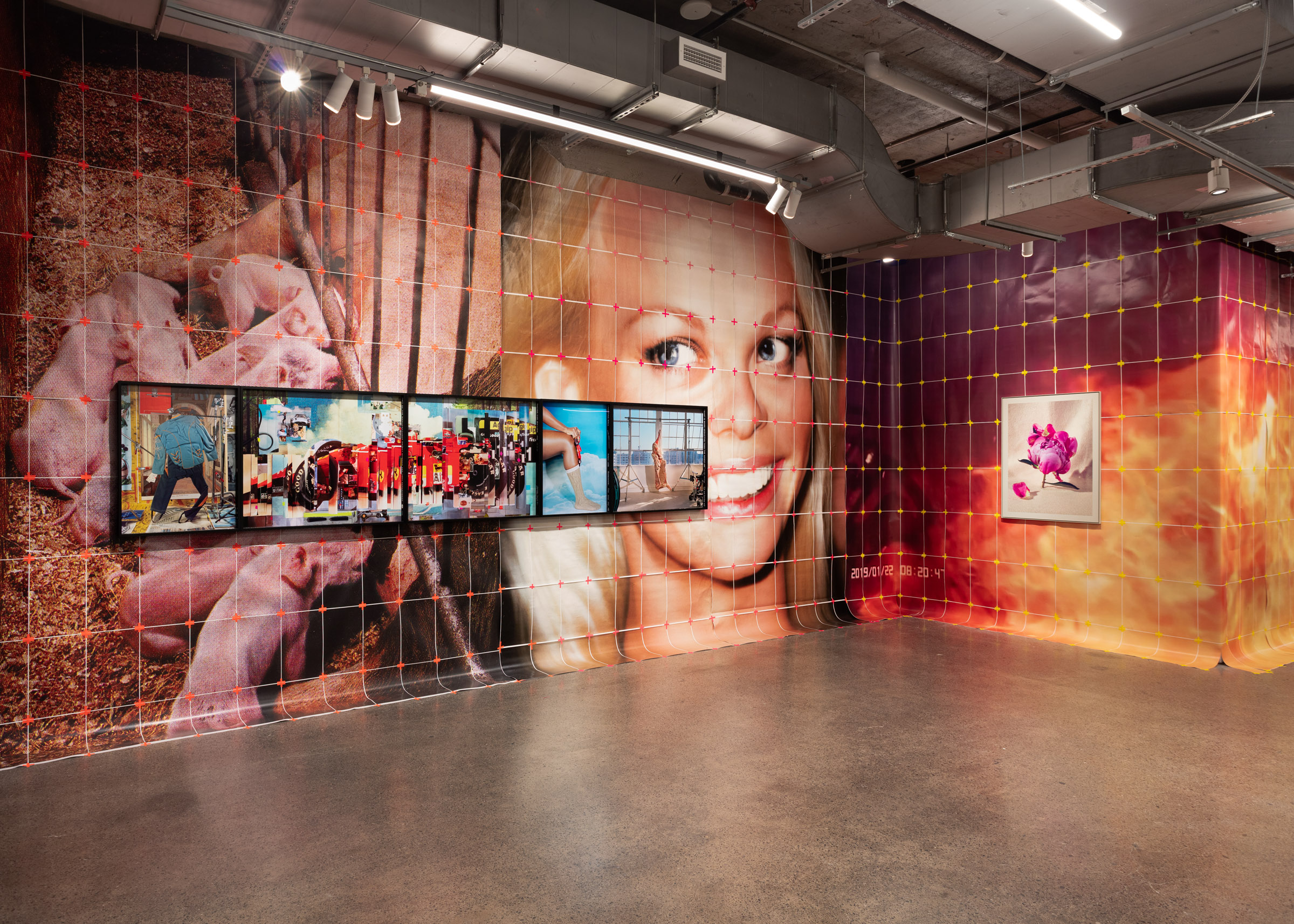
Nowhere is this more palpable than in Sara Cwynar’s Baby Blue Benzo Beta, a sprawling multimedia installation that transforms the museum into something between film set, archive, theatre, photo studio, showroom, and algorithmic feed. Spread across monumental projections, modular image panels, pinned photographs, sprawling wallpaper installations, and massive hand-affixed images assembled from tiled sheets of printer paper sutured together with visible seams of tape, the exhibition unfolds as a meditation on contemporary spectatorship itself. Throughout the installation, Cwynar repeatedly collapses distinctions between analogue and digital production, exposing the material labour typically concealed beneath the frictionless surfaces of contemporary image culture.
At the centre of the exhibition is Baby Blue Benzo (2024), a hypnotic twenty-two minute film orbiting the record-breaking auction of a 1955 Mercedes-Benz 300 SLR. Yet the vehicle itself quickly begins to dissolve into representation. The car appears as replica, archival image, cutout, animation, AI-generated rendering, museum object, cinematic fantasy. It no longer exists as a stable object so much as an endlessly circulating image-form, reproduced until the distinction between commodity, representation, and simulation collapses entirely.
Images drift horizontally across the screen in an uninterrupted conveyor belt of advertisements, stock photography, internet ephemera, found footage, diagrams, voiceovers, and philosophical quotations from Martin Heidegger, Guy Debord and the like. There’s a tongue-in-cheekness to the visual cacophony; a juxtaposition of visual elements and sonic motifs that blend pop-cultural references, including recurrent soundbites of Charli XCX’s “Porsche,” with a more meditative disposition towards the state of visual representation within our hyperreality. The film’s progression resembles a conveyor belt of image and sound, reflecting what Cwynar describes as the “boundless scroll of daily life,” where habitual clicks and swipes begin distorting one’s sense of time, place, and self. The movement of the film, according to Cwynar, appears progressive at first, technological even, yet gradually reveals itself as recursive. One step forward, two steps back. The film accelerates, reverses, loops, and fractures. Through countless iterations of visual references compiled in sequence, meaning never fully stabilizes before another image arrives to replace it.

This recursive structure and commentary on progress and temporality becomes especially potent through Cwynar’s invocation of Eadweard Muybridge, whose nineteenth-century motion studies helped establish the visual grammar that would eventually give rise to cinema, animation, and contemporary digital interfaces alike. Throughout Alphabet, Cwynar organizes sprawling constellations of found imagery, advertisements, diagrams, archival photographs, product shots, and visual fragments into modular alphabetized categories that evoke both the taxonomic logic of the archive and the endless associative drift of the algorithmic feed. The installation recalls the image constellations of Aby Warburg’s Mnemosyne Atlas, collapsing historical imagery, consumer culture, digital aesthetics, and visual memory into unstable systems of adjacency and circulation. Yet unlike the traditional archive, Alphabet resists any stable hierarchy of meaning. Celebrity images appear beside advertisements, philosophical references beside AI-generated imagery, childhood iconography beside commodity fetishism. The alphabetized structure initially appears rational and systematic, yet gradually reveals itself as arbitrary and unstable, mirroring the associative logic of contemporary algorithmic platforms where meaning emerges less through interpretation than through endless circulation, categorization, and recombination.
In one sequence within the exhibition’s “Touch” section, Mickey Mouse is extracted from animation and reorganized into a contemporary Muybridge-like sequence of fragmented movement images. Reaching outward frame by frame, Mickey appears suspended between cartoon character, commodity mascot, archival image, and interface gesture. His arms outstretched toward the spectator, one becomes acutely aware of both the uncanny fracturing of the temporal motion occurring across the adjacent film projection and Mickey’s gesture itself, the way his finger extends toward the invisible surface separating spectator from image. The gesture invokes the haptic logic of the infinite scroll and touchscreen interface, transforming the act of spectatorship into something tactile and reciprocal rather than passive. Mickey no longer simply performs for the viewer; he reaches outward toward them, collapsing the distance between interface, image, and body itself.

That inversion lingers throughout the exhibition. Cwynar does not position herself outside contemporary image culture, critiquing it from a distance. The work remains deeply seduced by spectacle even as it interrogates it. Glossy advertisements, luxury objects, internet aesthetics, celebrity imagery, pharmaceuticals, and AI-generated visuals collapse into one another with hypnotic intensity. Massive AI-generated images constructed from tiled sheets of printer paper and held together through visible seams of tape hang beside pinned photographs, stock imagery, advertisements, and sprawling wallpaper installations. Throughout the exhibition, distinctions between analogue and digital production repeatedly collapse into one another, exposing the material labour concealed beneath the seamlessness of contemporary image culture. Within Cwynar’s recursive visual stream, figures such as Pamela Anderson cease functioning as singular referents and instead operate as hyperreal image-forms. Rendered through Cwynar’s own short-films and editorial images of Anderson as well as AI-generated images of her which are constructed via massive assemblages of printer paper sutured together by tape, her likeness becomes an endlessly circulating motif across overlapping systems of simulation and reproduction. Rather than clarifying contemporary image culture, Cwynar’s kaleidoscopic accumulations intensify the very pressures they depict.
Inside MOCA’s former auto factory, this tension and intensity feels especially charged. The architecture itself becomes folded into the exhibition’s logic of industrial repetition and manufactured desire. Photography, advertising, automation, and commodity production begin collapsing into the same visual system. As the horizontal scroll continues endlessly across screens and walls, the spectator gradually loses any stable distinction between memory, fantasy, interface, and reality itself.

Rather than simply critiquing contemporary media culture, Cwynar’s installation inhabits its contradictions fully. The result is one of the most psychologically resonant and conceptually cohesive exhibitions presented at MOCA Toronto in recent years.

Cody Rooney is the Editor in Chief and senior contributor at liminul.
He is a PhD candidate, digital content specialist, writer, editor, multi-media artist, and photographer.